
Pahrump Wholesale Kitchen and Bathroom Cabinets · RTA vs Assembled Decision Guide
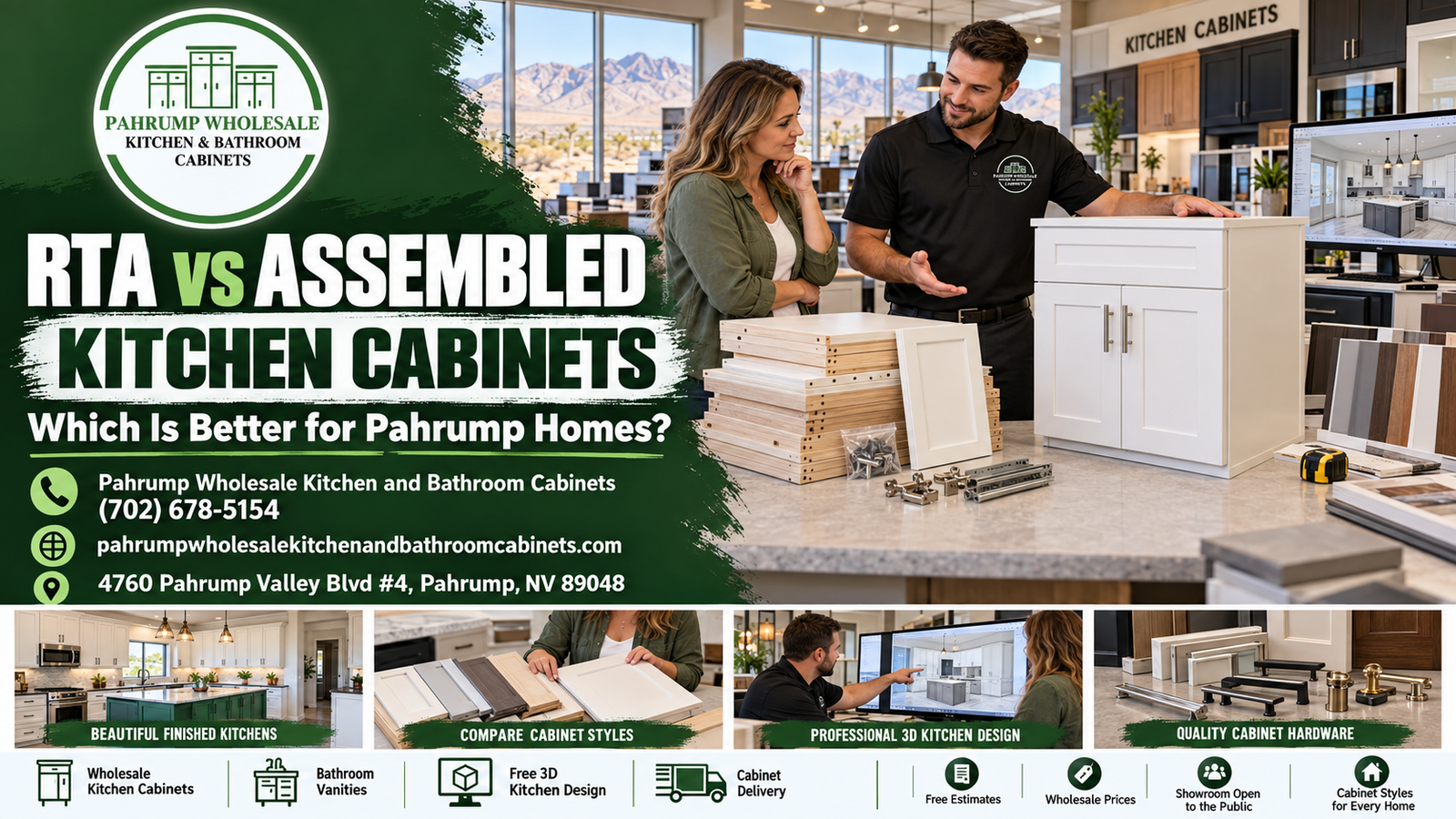
RTA vs Assembled Kitchen Cabinets: Which Is Better for Pahrump Homes?
Picture two kitchens on the same Pahrump street. In one, forty flat cartons arrive in the back of a pickup, and the owner spends three weekends in the garage with a mallet, a square, and a bottle of wood glue before the first box ever touches a wall. In the other, a delivery truck drops off finished boxes that take up the whole living room, and an installer starts hanging them the next morning. Both kitchens can end up looking the same. The difference is where the labor happens, who carries the risk of mistakes, and how the boxes survive the trip, the heat, and the dust along the way. This guide compares RTA vs assembled kitchen cabinets the way a careful buyer should: joinery and box construction, assembly hours and skill, shipping and damage risk, install paths, lead time, cost drivers, desert dryness, and the project types where each format earns its keep, from rentals and flips to vacation homes and the kitchen you plan to cook in for twenty years. Cost and time figures are educational ranges, not quotes. To see both formats in person, visit Pahrump Wholesale Kitchen and Bathroom Cabinets, 4760 Pahrump Valley Blvd #4, Pahrump, NV 89048, or call (702) 678-5154.
Are RTA or assembled kitchen cabinets better for Pahrump homes?
Neither format is better in every case. RTA (ready-to-assemble) cabinets usually win when the budget is tight, the layout is standard, and someone skilled and patient will assemble the boxes square in a clean, shaded, indoor space. Assembled cabinets usually win when time, labor certainty, and fewer chances for assembly mistakes matter more than the lowest product price, or when nobody on the project wants to build thirty boxes. RTA describes how cabinets ship, not how good they are. A well-engineered RTA line, assembled correctly, can outperform a poorly built assembled box, and the reverse is just as true. Judge the box material, joinery, drawer hardware, hinges, and finish first. Then choose the format that fits your labor, your schedule, your storage space, and the way you will use the home.
The cost and time figures on this page are educational ranges based on typical residential work, not quotes and not a price list from Pahrump Wholesale Kitchen and Bathroom Cabinets.
Local context: Serving Pahrump and Nye County homeowners, landlords, and contractors from the Carberry Square showroom at 4760 Pahrump Valley Blvd #4, Pahrump, NV 89048. Call (702) 678-5154 · Google Maps. Climate notes in this guide follow the National Weather Service Climate of Las Vegas summary, which describes the triple-digit summers, very dry air, and wind-driven dust that also shape assembly and storage conditions in nearby Pahrump.
What RTA and Assembled Cabinets Actually Mean (and What They Don’t)
Quick answer: RTA cabinets ship as flat, labeled panels with hardware, and someone builds each box before installation. Assembled cabinets leave the factory or warehouse as finished boxes ready to level and fasten. The words describe the shipping and labor format. They say nothing on their own about box material, joinery strength, hardware grade, or finish quality.
Shoppers run into a fog of labels: RTA, flat-pack, knock-down, pre-assembled, factory-assembled, in-stock assembled, built-to-order. Separate three questions and most of the confusion goes away.
Question one: who builds the box? With RTA, the sides, bottom, back, top rails or stretchers, shelves, and often the face frame arrive as separate parts. You, a helper, or an installer join them using the fastening system the manufacturer designed. With assembled cabinets, that work happened in a factory with jigs, clamps, and repetition, so the box arrives already square, or at least it should.
Question two: how is the box made? This is construction, and it is a separate decision. Plywood or particleboard sides, a full back or a thin back with hanging rails, dadoed joints or butt joints, dovetail drawers or stapled drawers, soft-close hardware or basic hinges. Each of those can show up in either format.
Question three: how flexible is the line? Stock lines offer fixed widths and finishes. Semi-custom lines add sizes, modifications, and finishes. Custom shops build to drawings. Most RTA lines sit in the stock tier, but plenty of assembled cabinets are stock too, and some lines are sold in both formats from the same catalog.
| Format | What arrives | Who does the box assembly | Typical fit |
|---|---|---|---|
| RTA / flat-pack | Labeled panels, face frame or edge-banded fronts, doors, drawer parts or pre-built drawers, hardware bags, instructions | Homeowner, handyman, installer, or a seller that offers assembly as a service | Budget remodels, rentals, flips, standard layouts, owners with time and a clean workspace |
| Assembled stock | Finished boxes, usually with doors and drawers attached or packed alongside | Factory or distributor before you buy | Owners who want fast installs and fewer moving parts, standard sizes and finishes |
| Assembled built-to-order (semi-custom or custom) | Finished boxes built for your order, often with modified sizes or finishes | Factory or shop | Irregular layouts, specialty finishes, owners who need sizes stock lines do not carry |
A quick note on wording you may hear at a counter. “Pre-assembled” and “factory-assembled” usually mean the same thing. “Knock-down” is a trade term for RTA, especially in furniture. “In-stock” describes availability, not format, so an in-stock cabinet can be RTA or assembled. When you compare two quotes, write the format, the construction, and the availability for each line in separate columns. Two quotes that look similar on price may be comparing a flat-pack particleboard box to a pre-built plywood box, and that is not a fair fight.
If you are brand new to the format, the older primer what RTA cabinets are and whether they suit a Pahrump remodel covers the basics. This guide goes further: it is the side-by-side decision, with the trade-offs that only show up during assembly, delivery, installation, and the first few years in a desert house.
Honesty rule for this section: If a seller treats “assembled” as a synonym for “better” or “RTA” as a synonym for “cheap,” ask to see the box material, back panel, joinery, drawer construction, hinge adjustment, and written warranty for each option. The format changes who does the labor. The specifications decide what you actually own.
Box Construction and Joinery: How Each Format Holds Together
Quick answer: Factory-assembled boxes are usually joined with glue, dadoes or grooves, staples or pin nails, and corner blocks while clamped square. RTA boxes rely on engineered mechanical fasteners such as cam locks, dowels, metal clips, or interlocking grooves, sometimes with glue added during assembly. Both systems can produce a strong, square cabinet. Weakness usually comes from thin materials or careless assembly, not from the format itself.
A cabinet box is a simple structure doing a demanding job. It carries countertop weight, resists racking when someone leans on an open door, holds screws for hinges and slides through thousands of cycles, and stays square enough that doors line up. The way the parts are joined decides how well it does all of that, and that is where RTA and assembled cabinets differ most.
1
Factory joinery on assembled boxes
How it works. Panels are cut and machined, then glued and fastened in a case clamp that pulls the box square. Better lines house the bottom and back in dadoes or grooves, add corner blocks or gussets at the top, and use glue at every joint so the box behaves as one piece. Entry lines may lean more on staples and less on housed joints.
What it gives you. Consistency. A factory that builds thousands of identical boxes gets the diagonals right far more often than a first-time assembler working on a garage floor.
What to check. Look inside for glue squeeze-out at joints (a sign glue was used), dadoed bottoms rather than a bottom simply stapled up from underneath, and corner blocks in base cabinets where countertop weight bears down.
2
Cam-lock and dowel systems
How it works. A round cam housing sits in one panel, a steel bolt threads into the mating panel, and a quarter to half turn of the cam pulls the joint tight. Wood dowels align the parts and add shear strength. This is the classic flat-pack approach.
What it gives you. Fast assembly with basic tools, and joints that can be re-tightened if the box loosens.
What to check. The quality of the cam hardware, how deep the bolt threads into the panel core, and whether the manufacturer allows or recommends glue on the dowels. Cam locks set into low-density particleboard can strip if overtightened. Cam locks in plywood or high-density board hold far better.
3
Metal clip and interlocking systems
How it works. Many current RTA cabinet lines use steel corner clips or locking brackets that snap or slide into routed slots, often paired with tongue-and-groove edges between panels. Framed RTA lines commonly have a pre-assembled face frame with grooves on the back that the box sides slide into.
What it gives you. A tight, repeatable joint with less dependence on the assembler’s judgment. Some systems go together with a mallet and almost no screws.
What to check. Whether the clips are steel or plastic, how many clips each joint uses, and whether the instructions call for glue in the grooves. A clip system with glue becomes close to a permanent joint, which is usually what you want in a kitchen.
4
Glue-and-screw RTA assembly
How it works. Some lines ship pre-drilled panels designed for confirmat screws or pocket screws, with glue applied by the assembler. In practice this behaves a lot like a site-built cabinet.
What it gives you. Very strong joints when done carefully.
What to check. Clamp access, squareness during glue cure, and whether you have enough flat space to let boxes sit undisturbed while glue sets.
| Component | Common on assembled boxes | Common on RTA boxes | What matters more than format |
|---|---|---|---|
| Side panels | Particleboard, MDF, or plywood, glued into the box | The same materials, joined with clips, cams, or screws | Panel thickness and core density; screw-holding at hinge plates |
| Back panel | Full back housed in grooves, or thin back with hanging rails | Full back sliding into grooves, or thin back plus rails | A rigid back resists racking; thin backs need solid hanging rails |
| Bottom | Dadoed into sides or stapled from below | Grooved, clipped, or cammed | Support under heavy items and resistance to sink-base leaks |
| Face frame (framed lines) | Glued and pinned to the box | Often pre-built; box slides into grooves behind it | Frame squareness and hardwood vs composite frame material |
| Drawer boxes | Arrive built | Often arrive pre-built even in RTA lines; sometimes flat-pack | Dovetail or doweled joints, bottom thickness, slide type and rating |
| Doors | Hung and adjusted at the factory or on site | Shipped separately, wrapped, hinges attached on site | Door construction, hinge adjustability, finish quality on edges |
The Kitchen Cabinet Manufacturers Association (KCMA) runs an A161.1 quality certification that tests cabinets for structural strength, door and drawer integrity, and finish durability, and it notes that certified cabinets exist at every price point. Certification is worth asking about in either format because it shifts the conversation from marketing words to third-party testing. It is not a replacement for opening a drawer and pushing on a box yourself.
One structural point gets lost in most RTA debates. A cabinet installed in a kitchen is not a freestanding box. It is screwed to wall studs through a hanging rail, screwed to its neighbors through the face frame or side panels, shimmed level, and capped with a countertop that ties the run together. Much of the long-term rigidity comes from that system. A slightly flexible RTA box that is square, glued where allowed, and properly fastened into a run will usually perform better than a rigid factory box that was hung out of level on a wavy wall. Box strength matters. Installation quality matters at least as much.
The flip side is that RTA puts the most critical step, assembling a square box, in the hands of whoever opens the cartons. A factory controls diagonal measurements on every box. A tired homeowner on box twenty-six at 9 p.m. may not. That is the real construction trade-off between formats: not strength on paper, but the consistency of the person or machine doing the joining. For a hands-on look at the quality signals that apply to any cabinet, see how to tell if kitchen cabinets are good quality, and for the RTA-specific version, whether RTA cabinets are good quality for Pahrump homes.
Diagnostic clue: Ask the showroom to show you an assembled sample of the RTA line you are considering. Push sideways on the top corner of the box. If it shifts visibly before a countertop or wall is attached, the joinery or back panel is light. If it feels solid, the system is doing its job. Do the same test on the assembled line and compare.
Assembly Time, Skill, Tools, and Space: The Hidden Half of RTA
Quick answer: As an educational planning range, a first-time assembler often spends about 45 to 90 minutes on a standard base or wall cabinet and longer on drawer bases, sink bases, corner units, and tall pantries. A 25- to 35-box kitchen can easily take 25 to 50 or more hours for a beginner, plus room to stage the finished boxes. Experienced crews work much faster. Assembled cabinets skip this step entirely.
RTA savings are real, but they are paid for in hours. The most common regret people describe after a flat-pack kitchen is not about quality. It is about time: “I thought it would take a weekend.” A bookshelf takes an evening. A kitchen is thirty bookshelves that all have to be square, all have to line up, and all have to survive a countertop.
Educational time ranges by cabinet type
| Cabinet type | First-time assembler (educational) | Experienced assembler (educational) | Why it takes longer or shorter |
|---|---|---|---|
| Wall cabinet, single or double door | About 30–60 minutes | About 15–30 minutes | Few parts; hinges and shelf pins add time |
| Standard base cabinet | About 45–90 minutes | About 20–40 minutes | Toe kick, stretchers, drawer over door |
| Drawer base (three or four drawers) | About 1–2 hours | About 30–60 minutes | Slide installation and drawer front alignment |
| Sink base | About 45–90 minutes | About 20–40 minutes | False fronts, open back or bottom cutouts for plumbing |
| Blind or lazy-susan corner | About 1.5–3 hours | About 45–90 minutes | Odd geometry, bifold doors, rotating hardware |
| Tall pantry or oven cabinet | About 1.5–3 hours | About 45–90 minutes | Large panels, needs two people to square and stand |
These ranges are educational and vary by product line. Some modern clip systems go together faster than the low end. Lines that call for glue at every joint take longer because boxes must sit square while glue sets. Your first few boxes will be slow; plan the calendar for that pace.
Skills that actually matter
- Reading exploded diagrams patiently. Most assembly errors come from a panel flipped end for end or inside out, which you discover three steps later.
- Measuring diagonals. A box is square when both diagonal measurements match. Checking every box before the glue sets is the single most valuable habit.
- Torque control. Cam locks and screws strip when overtightened, especially in particleboard. A drill with a clutch set low, or a hand screwdriver for the final turn, prevents most damage.
- Hardware sorting. Kitchens use several screw lengths that look nearly identical. A wrong-length screw can poke through a finished side panel.
- Two-person lifting. Tall cabinets and large base boxes need a helper to stand, square, and move without racking the joints.
Tools and supplies for a smooth RTA build
Rubber or dead-blow mallet, cordless drill/driver with an adjustable clutch, Phillips and square bits, tape measure, framing square, utility knife used carefully on cartons only.
Bar or corner clamps, a 4-foot level, painter’s tape and a marker for labeling, and a notepad listing every box by its position on the layout drawing.
Moving blankets or the carton cardboard laid flat as a work surface, a soft brush or compressed air for dust, damp cloth for glue squeeze-out, and bins for hardware.
Staging space: the part nobody measures
An assembled base cabinet needs roughly as much floor space as a small end table, and you cannot stack finished boxes safely without risking scratches and racked corners. A full kitchen of assembled boxes can fill a single-car garage bay or a living room. That is true whether you assemble RTA yourself or receive pre-assembled boxes. The difference is timing. RTA cartons stack compactly until you build, so you can assemble in batches in the order the installer will hang them. Assembled cabinets arrive all at once and need floor space from day one.
In Pahrump, that space question has a climate twist. A detached garage or shed may feel like the obvious workshop, but in summer an uninsulated garage can run far hotter than the house. Heat shortens the working time of wood glue, makes your hands sweat onto finished surfaces, and pushes people to rush. The section on desert dryness, heat, and dust covers this in detail. Short version: assemble indoors or in a conditioned space during the cooler part of the day whenever possible.
1
A sensible RTA assembly sequence
Inventory first. Open every carton and check parts against the packing list before assembling anything. Many freight and manufacturer claim windows are short. Finding a cracked door panel on day one is a phone call. Finding it after demolition is a delay.
Label to the drawing. Mark each carton and each finished box with its position code from the layout, such as B1, W3, or SB36. Installers hang in sequence, and a labeled garage saves hours.
Build a test box. Start with a simple wall cabinet. Learn the system on the box that matters least.
Square, then set. Check diagonals before glue cures or before you drive the last fasteners. If the diagonals differ by more than about 1/8 inch on a standard box, correct it now.
Hold doors and drawer fronts. Many installers prefer to hang doors after the boxes are fastened to the wall. Keep doors wrapped and flat until then.
Stop rule: If a box will not pull square, a cam spins without tightening, or a panel arrives cracked at a joint, stop and call the seller before forcing it. A forced joint can look fine on the floor and fail once a 200-pound stone countertop sits on top.
If you have built furniture from flat packs and enjoyed it, own a decent drill, and have a clean indoor room for two or three weekends, RTA assembly is a reasonable project. If your idea of a fun Saturday does not involve diagrams and hardware bags, the hours are a cost, and the honest comparison is RTA plus paid assembly versus assembled cabinets. The older post are RTA cabinets a good choice for a kitchen remodel lists some of the situations where that labor makes sense.
Shipping, Handling, and Damage Risk on the Way to Pahrump
Quick answer: RTA cartons are compact, dense, and easier to move in a pickup or SUV, but individual panels can arrive cracked or with crushed corners. Assembled boxes are bulky and need more truck space, and their corners, face frames, and finished ends are exposed to bumps. Either way, inspect every carton at delivery, note damage on the delivery paperwork, and photograph it before signing.
Format changes the logistics of getting cabinets from a warehouse to your kitchen, and in Pahrump the distance and the roads make that more than a footnote. Many homeowners compare options across the Pahrump-Las Vegas drive, which is roughly an hour each way. Some lots sit on unpaved or rough access roads. Summer delivery means cartons may sit in a hot truck or on a sunny driveway.
| Handling factor | RTA / flat-pack | Assembled |
|---|---|---|
| Volume per kitchen | Compact; cartons stack, so a small kitchen may fit in one pickup load | Several times the volume; often needs a box truck, trailer, or multiple trips |
| Weight per piece | Cartons can be heavy for their size but are usually one-person or two-person lifts | Tall and wide boxes are awkward; two people needed for most moves |
| Typical damage | Cracked panel edges, crushed carton corners, chipped edge banding, scratched door faces | Dented corners, racked boxes, cracked face-frame joints, scuffed finished ends |
| Concealed damage | Hard to see until you unpack every panel | Easier to spot visually, but racking may not show until install |
| Replacement | Often a single panel or door can be reordered | Often the whole box is replaced, which can take longer |
| Storage before install | Stacks in a corner; low footprint | Needs open floor space; cannot stack safely |
The replacement row deserves attention. With RTA, damage is often limited to one part, and some lines can ship that part alone. With an assembled box, a cracked side panel may mean replacing the entire cabinet, which can take longer if that size is not in local stock. Ask the seller how replacement parts work for each line before you buy. That single answer can matter more than a small price difference.
Delivery-day routine that protects you
- Count cartons or boxes against the delivery paperwork before the driver leaves.
- Look for crushed corners, punctures, and water stains on cartons; on assembled boxes, check corners, face frames, and finished ends.
- Photograph any visible damage with the label showing, and write a short description on the delivery receipt before signing.
- Move cartons into shade or indoors quickly in summer. Do not leave them on a sunny driveway through the afternoon.
- Unpack and inspect within the window the seller or freight carrier specifies, even if installation is weeks away.
Picking up yourself
Self-pickup is where RTA shines. A compact flat-pack order can ride in a pickup bed under a tarp, strapped flat, for a short drive across town. Assembled cabinets in an open truck bed are a different story: wind on the highway, gravel on a dirt road, and an unsecured tall cabinet can turn a savings run into a replacement order. If you pick up assembled boxes, use a covered trailer or box truck, pad every contact point, strap gently so you do not crush corners, and drive slowly on rough approach roads. Monsoon storms in July and August can also arrive fast with wind and heavy rain, so check the forecast before an open-bed trip.
Diagnostic clue: A carton with one crushed corner usually means a corner panel or door edge took the hit. Open that carton first and inspect the corresponding parts. A clean carton is not a guarantee, but a damaged one is a strong hint where to look.
Delivery and pickup options differ from seller to seller and line to line. Ask the showroom what is stocked locally, what ships from elsewhere, how delivery is scheduled to your address, and what happens if something arrives damaged. The sibling guide on how long it takes to order kitchen cabinets in Pahrump explains why replacement parts and freight can quietly decide your schedule.
Install Paths: DIY, Hired Helper, or Licensed Nevada Contractor
Quick answer: Hanging and leveling cabinets is the same job whether boxes started as RTA or arrived assembled. RTA simply adds an assembly step before installation. Decide who will assemble, who will install, and who handles plumbing, electrical, and gas before you order, and verify licensing with the Nevada State Contractors Board when the scope requires a licensed contractor.
There are four common install paths, and the cabinet format fits each one differently.
1
Full DIY: you assemble and install
Best format fit. RTA is the natural match because you capture both the product savings and the labor savings.
What it demands. Assembly skill, plus layout, leveling, scribing fillers, fastening to studs, and adjusting doors and drawers. Installation is the harder half. Floors in older homes and manufactured homes are rarely flat, and walls are rarely plumb.
Where it goes wrong. Starting the first base cabinet at the wrong height, skipping a laser or long level, or hanging uppers before confirming appliance and hood clearances. The National Kitchen & Bath Association (NKBA) publishes planning guidelines that designers use for clearances and work aisles, which are worth checking before the first screw goes in.
2
You assemble, a pro installs
Best format fit. RTA, with a clear understanding of what condition the boxes must be in when the installer arrives.
What it demands. Boxes assembled square, labeled, and staged in hang order. Talk to the installer first. Some are happy to hang owner-assembled boxes. Others prefer to inspect or assemble themselves because a poorly assembled box can make them look bad.
Where it goes wrong. The installer finds racked boxes on the morning of the install and either has to fix them on the clock or refuse to proceed.
3
A pro assembles and installs RTA
Best format fit. RTA, when the product savings still beat the extra labor after assembly is priced in.
What it demands. An installer who assembles RTA routinely and quotes assembly as a separate line so you can compare it against assembled cabinets.
Where it goes wrong. The assembly charge is vague or bundled, so you cannot tell whether RTA actually saved anything.
4
Assembled cabinets, professionally installed
Best format fit. Assembled, especially when the schedule is tight or the layout is complex.
What it demands. Floor space for staging and a delivery plan that gets boxes into the house without damage.
Where it goes wrong. Boxes arrive before the room is ready and sit for weeks in a hallway or garage collecting dust and dings.
Licensing and trade boundaries in Nevada
Buying cabinets and installing cabinets are often separate transactions. If you hire someone to install, check whether the scope requires a licensed contractor and verify that license with the Nevada State Contractors Board before work begins. The Board’s site lets you look up a license and see its classification and status. Nevada law includes narrow exemptions for some small jobs, but they come with conditions, and a full kitchen with plumbing and electrical changes rarely fits them. When in doubt, ask the Board, not a forum thread.
Measure, install, and trade boundary: Hanging boxes, setting shelves, and adjusting hinges are reasonable owner tasks for many people. Moving a sink drain, adding a circuit for under-cabinet lighting, relocating a gas line for a range, or venting a hood through an exterior wall are trade work. Those belong to licensed plumbers, electricians, and contractors as Nevada rules require. The cabinet format does not change that boundary.
If your Pahrump home was built before 1978 and the remodel will disturb painted surfaces during demolition, lead-safe practices may apply. The EPA’s Renovation, Repair and Painting (RRP) program explains when contractors must be certified and what lead-safe work looks like. Many Pahrump homes are newer, but older houses and some early manufactured homes exist, so it is worth confirming your build year before tearing out old cabinets.
Warranty is the last install question. Some manufacturers exclude problems caused by improper assembly or installation. That matters more for RTA because the assembler is part of the chain. Ask the seller, in writing, what the warranty covers when the owner assembles, when a hired installer assembles, and when the box arrives factory-assembled.
Lead Time and Project Schedule: Fast Delivery Is Not the Same as Ready to Hang
Quick answer: In-stock RTA and in-stock assembled cabinets can both be available quickly, while built-to-order assembled cabinets often take several weeks. But RTA delivery is only half the timeline. Add assembly hours to get the real “ready to install” date, then compare that date to the assembled option.
Shoppers often compare formats on delivery date alone. The better comparison is the date boxes are ready to hang. For an in-stock RTA kitchen, that is delivery plus inventory plus assembly. For in-stock assembled cabinets, it is delivery plus a quick inspection. For built-to-order lines, it is the factory lead time plus freight.
| Path (educational) | Product availability | Added time before install | Schedule risk to plan for |
|---|---|---|---|
| In-stock RTA, owner assembles | Often days when stocked locally | Roughly 2–5 weekends for a beginner on a full kitchen | Assembly runs long; a damaged panel needs replacing |
| In-stock RTA, pro assembles | Often days when stocked locally | Often 1–3 working days depending on crew and kitchen size | Crew availability; assembly priced and scheduled separately |
| In-stock assembled | Often days to a couple of weeks | Inspection only | Storage space; delivery logistics for bulky boxes |
| Built-to-order assembled (semi-custom or custom) | Often several weeks or more, varies by line | Inspection only | Factory slot timing; a wrong size takes another full cycle |
Actual availability depends on the line, current stock, and season. Ask the showroom to confirm stock status for the exact sizes on your layout, not just the door style. A style that is “in stock” may still be missing the 15-inch drawer base or the 36-inch sink base your kitchen needs.
Where each format protects your calendar
- RTA protects you when one part is damaged, because a single panel or door can sometimes be replaced faster than a whole box.
- RTA protects you when you need to stage cabinets for weeks before demolition, because cartons store compactly.
- Assembled protects you when the kitchen is already torn out and every day without a sink hurts, because installation can start as soon as boxes arrive.
- Assembled protects you when your helpers are only available for a short window, because nobody burns that window on assembly.
A practical rule for any remodel: do not demolish the old kitchen until the new cabinets are on site, inventoried, and, for RTA, at least partly assembled. The sibling guide on the best time to replace kitchen cabinets in Pahrump covers seasonal timing, including why many owners prefer to assemble and install outside the peak summer heat.
Diagnostic clue: If your countertop fabricator needs to template on installed boxes, every day of RTA assembly pushes the countertop date back by the same amount. Work backward from the countertop appointment, not forward from cabinet delivery.
Cost Drivers: Where RTA Saves Money and Where Assembled Earns Its Price
Quick answer: In educational 2026 planning terms, many RTA lines are discussed at roughly $100–$300 per linear foot for materials and many assembled stock lines at roughly $150–$400 per linear foot, with built-to-order lines higher. The RTA discount mostly reflects factory labor and freight volume. Add assembly labor, mistakes, and time before you call either option cheaper.
The per-linear-foot bands above match the broader educational ranges in the sibling guide how much kitchen cabinets cost in Pahrump, NV in 2026. They are planning estimates drawn from general industry conversation, not quotes, and not prices from Pahrump Wholesale Kitchen and Bathroom Cabinets. Bands overlap heavily, because a plywood RTA box with dovetail drawers can cost more than an entry assembled box with stapled drawers. Here, the goal is to show which cost lines move when you switch formats.
| Cost line | RTA | Assembled | How to compare fairly |
|---|---|---|---|
| Cabinet product | Often lower for similar construction | Includes factory assembly labor | Compare the same box material, back, drawers, and hardware |
| Freight and delivery | Compact cartons; may cost less per kitchen | More volume; may cost more per kitchen | Ask whether delivery is included, extra, or self-pickup |
| Assembly labor | Your hours, or a separate paid line | Already included | Get assembly quoted as its own line, per box or hourly |
| Install labor | Same hang work; some installers charge more if they also assemble | Hang work only | Ask the installer to quote both scenarios on the same layout |
| Mistakes and replacements | Risk sits with the assembler | Risk mostly sits with the factory | Ask how damaged or mis-assembled parts are handled |
| Fillers, panels, trim | Same need | Same need | Make sure both quotes include them, or neither does |
| Your time | Often 25–50+ hours for a beginner on a full kitchen | Close to zero for assembly | Put an honest value on weekends |
Run the comparison as two totals, not two sticker prices
Ask for two educational totals on the same layout. Total A is RTA product plus delivery plus assembly (paid or your own hours) plus install. Total B is assembled product plus delivery plus install. If Total A is lower by enough to justify the time and risk, RTA wins on cost. If the gap narrows to a few hundred dollars after paid assembly, assembled often wins on schedule and certainty.
1
Where RTA savings are real
DIY-capable households. If you will assemble anyway, the factory-labor portion of the price stays in your pocket.
Multiple units. Landlords and investors who repeat the same kitchen in several units get faster at assembly with each one, so per-box labor drops.
Long-haul freight. Dense flat packs can reduce freight cost when product travels a long distance before it reaches southern Nevada.
2
Where RTA savings disappear
Paid assembly. Once you pay someone to build every box, part of the price gap closes.
Assembly errors. A stripped cam, a wrong screw through a finished side, or a racked box that needs rebuilding all cost money or time.
Rushed schedules. If the kitchen is already gutted, slow assembly can mean extra weeks of takeout and a delayed countertop slot.
3
Where assembled earns its premium
Labor certainty. Installers can quote hang time more tightly when boxes arrive square.
Fewer failure points. Factory joints are made with clamps and jigs that a garage floor cannot match.
Faster turnover. For a rental between tenants or a listing on a deadline, days matter.
Wholesale distribution can lower the product side for either format, but “wholesale” is a buying channel, not a construction grade. For the channel comparison, read whether wholesale kitchen cabinets are worth it in Pahrump and big-box cabinets vs local wholesale cabinets. If you are comparing RTA against a national retail line specifically, RTA cabinets vs Home Depot cabinets covers that matchup.
Honesty rule for this section: Percent-savings claims for RTA versus assembled appear often in marketing. Treat them as directional at best, because they only hold when the two products share the same construction. Compare specifications line by line, then compare totals.
Weighing RTA Against Assembled for Your Kitchen?
Bring your layout, rough measurements, and a realistic note on who will assemble and who will install. At the showroom you can ask to see an assembled sample of a flat-pack line beside a pre-built box, open drawers, check backs and joinery, and confirm which sizes are in stock in each format. Pahrump Wholesale Kitchen and Bathroom Cabinets is at 4760 Pahrump Valley Blvd #4, Pahrump, NV 89048 (Carberry Square).
Desert Dryness, Heat, and Dust: How Pahrump Conditions Affect Each Format
Quick answer: Very dry air, summer heat, and wind-driven dust affect RTA more during assembly and staging, because glue sets faster, panels pick up dust in fastener holes, and hot garages invite rushed work. Once installed, both formats face the same risks: wood movement in solid parts, edge swelling near sinks, and finish wear from sun and grit.
The NWS Climate of Las Vegas summary describes the region as the driest major metropolitan area in the continental United States, with abundant sunshine, summer highs into the triple digits, and spring and fall winds that carry blowing dust and sand. A July and August monsoon push brings higher humidity and scattered storms for a few weeks. Pahrump sits west of the Las Vegas Valley over the Spring Mountains, but the same broad Mojave pattern shapes how cabinets behave there. Treat this as regional context, not a Pahrump building code.
During assembly and staging (affects RTA most)
- Glue sets faster. Wood glue’s working time shortens in heat and very dry air. Boxes that need squaring after glue goes on give you less time to adjust. Assemble in a conditioned room, glue one joint group at a time, and check diagonals right away.
- Hot garages encourage shortcuts. An uninsulated garage on a summer afternoon is a bad place for careful work. Assemble early in the morning or indoors.
- Dust in fastener holes and grooves. Fine dust in a cam hole or a back-panel groove can stop parts from seating fully. Keep cartons closed until needed and brush or blow out grooves before joining.
- Heat-sensitive surfaces. Some wrapped or laminated finishes do not like prolonged heat. Follow the manufacturer’s storage guidance and never leave cartons in direct sun.
Acclimation before assembly or install
Many manufacturers recommend letting cabinets acclimate in the room where they will be installed, at normal living temperature, before assembly or installation. Follow the specific line’s guidance. The idea is the same for both formats: let solid wood face frames, doors, and panels reach the indoor conditions they will live in so they move before they are fastened, not after. In a Pahrump summer, moving cartons from a hot truck straight into an air-conditioned room is a big swing, so give them time.
After installation (affects both formats)
Solid wood rails, stiles, and face frames shrink slightly in very dry air. Painted five-piece doors may show hairline lines at joints over time. Stable panels such as MDF centers under paint reduce this.
Particleboard and MDF edges swell if water sits on them. Hard water near sinks leaves spots and mineral film. Seal cut edges at plumbing holes, use a sink base mat, and wipe spills quickly.
Dust settles on top of wall cabinets and inside drawer slides. Wipe tops and vacuum slide tracks a few times a year, more often after windy weeks.
Strong light through west- and south-facing windows can shift color on stained wood and some finishes over years. Window treatments help both formats equally.
One desert-specific point favors careful RTA assembly. The sink base in an RTA kitchen is often cut by the installer for plumbing. Raw cut edges in particleboard soak up water fast. Seal them with a compatible sealer or edge tape before the plumbing goes back in. Factory-assembled sink bases may have pre-cut, sealed openings, or they may still need on-site cuts, so check either way.
Diagnostic clue: If a door that closed perfectly in spring starts rubbing in late summer, humidity changes from the monsoon may be moving a solid wood part slightly. A quarter turn on the hinge adjustment screws usually fixes it. That is normal wood behavior, not a format failure.
Rentals, Flips, Vacation Homes, and Forever Homes: Matching Format to the Property
Quick answer: RTA often fits rentals, flips, casitas, garages, and budget-driven vacation homes where standard sizes work and someone can assemble efficiently. Assembled cabinets often fit forever homes, gutted kitchens on a deadline, and owners who would rather pay for labor certainty. Manufactured homes can work with either format if measurements and wall fastening are planned carefully.
The right format depends less on the cabinet and more on the property and the person paying for it. Pahrump has a wide mix: stick-built ranch homes, newer subdivisions, manufactured homes on large lots, second homes for people based elsewhere, and rentals. Here is how the decision tends to break down.
| Project type | Common lean | Why | Watch for |
|---|---|---|---|
| Long-term rental | RTA, if assembled well | Controls cost per unit; parts can be replaced individually after tenant damage | Choose durable finishes and sturdy drawer slides; tenants are hard on hardware |
| Fix-and-flip | Depends on schedule | RTA saves money if the crew assembles fast; assembled saves days on a carrying-cost clock | Price the crew’s assembly time honestly against holding costs |
| Vacation or second home | Either | Owners visiting for short stays rarely have time to assemble; local help may assemble RTA | Coordinate delivery when someone is on site; do not leave cartons in a hot, empty house for weeks |
| Forever home | Lean assembled, or premium RTA built carefully | Daily use for many years rewards factory consistency and better construction | Spend on drawers, hinges, and box material before format convenience |
| Manufactured home | Either, with care | Lighter, standard-size RTA can suit; assembled boxes must fit through doors and hallways | Wall framing, floor flatness, and fastening points differ from stick-built homes |
| Casita, ADU, or guest quarters | RTA often | Small runs, standard sizes, budget focus | Match finish to the main house if visible together |
| Garage, laundry, or workshop | RTA often | Function over finish; easy to transport | Heat in uninsulated garages; choose finishes that tolerate it |
1
Rentals: repairability beats perfection
Why RTA often fits. A landlord with several units can standardize on one line and one color, learn the assembly system once, and keep a few spare doors and drawer fronts. When a tenant cracks a door, a matching part from the same line is far easier to source than a custom replacement.
Where assembled still wins. When the unit is empty and losing rent every day, the faster install of assembled boxes can outweigh the product savings.
2
Flips: the clock decides
Why it is close. A flipper’s carrying costs run every day the house is not listed. If the crew can assemble an RTA kitchen in a day or two while other trades work, RTA wins. If assembly would stall the schedule, assembled cabinets pay for themselves. Buyers notice clean, aligned doors and soft-close drawers; they do not ask how the box shipped. For buyer perception without invented return percentages, see whether new kitchen cabinets can improve home value in Pahrump.
3
Vacation and second homes: logistics first
The real question. Who is in town to receive the delivery, inspect cartons, and assemble? Owners who fly or drive in for short visits often find assembled cabinets simpler, or they hire local help to assemble RTA. Cartons left for weeks in a closed-up house with the air conditioning set high can heat up. Plan delivery for a visit, or arrange for someone to receive and store the order indoors.
4
Forever homes: invest in the parts you touch
Where to spend. In a kitchen you will cook in for fifteen or twenty years, drawer slides, hinges, box material, and finish quality matter far more than the shipping format. A premium RTA line with plywood boxes and good hardware, assembled patiently, can be an excellent forever kitchen. So can an assembled line. Do not choose an entry assembled box over a better-built RTA box just to avoid assembly, and do not choose a thin RTA box just to save money on a kitchen you will live with every day.
5
Manufactured homes: measure the path, not just the wall
The overlooked step. Assembled tall pantries and long base boxes must travel through exterior doors, hallways, and tight turns. RTA cartons fit through almost anything. Walls in manufactured homes may also use different framing and fastening points than stick-built houses, and floors may need shimming. Either format can work. Measure doors and hallways before ordering assembled boxes, and plan how each cabinet will be fastened.
Neighborhood context also matters. A remodel in a newer part of town may be compared against recent builder kitchens, while a rural lot with a manufactured home may prioritize durability and cost. The neighborhood pages for Mountain Falls and Calvada and Comstock Park give local framing if you want to think about your area specifically.
Quality Checks That Apply to Both Formats
Quick answer: Inspect the same things on RTA and assembled cabinets: box material and thickness, back panel, joinery, drawer box construction, slide and hinge quality, finish on edges and finished ends, compliance labeling, and written warranty terms. For RTA, add the quality of the fastening system, the clarity of instructions, and how replacement parts are handled.
Use this checklist on a showroom sample and again on delivery day.
| Check | What good looks like | Extra RTA question | Extra assembled question |
|---|---|---|---|
| Box material | Panels that hold screws firmly; plywood or dense board with clean edges | How deep do cams or screws engage the panel core? | Is the box glued and housed, or only stapled? |
| Back panel | Full back in grooves, or a thin back with solid hanging rails | Does the back slide into grooves that square the box? | Is the back fastened all around, not just tacked? |
| Drawer boxes | Dovetail or doweled joints; bottom that does not flex under load | Do drawers arrive pre-built, or must you assemble them? | Do drawers run straight and close evenly out of the box? |
| Slides and hinges | Smooth, quiet, soft-close where specified; adjustable in several directions | Are hinge and slide holes pre-drilled accurately? | Are doors already adjusted, and are hinges labeled or branded? |
| Finish | Even color and sheen; sealed edges; finished ends that match doors | Are door edges protected in packaging? | Any scuffs on corners or finished ends from transit? |
| Square and level | Matching diagonals; doors with even reveals | Does the system pull square easily? | Is any box racked from shipping? |
| Compliance and certification | Composite wood compliance labeling; certification if claimed | Is the label on the carton or the parts? | Is the label inside the box? |
| Warranty | Written terms you have read | Does it cover owner assembly or require a professional? | What counts as installation damage? |
Composite wood and indoor air
Most cabinet boxes in both formats use composite wood such as particleboard, MDF, or hardwood plywood. In the United States these products are subject to formaldehyde emission limits under rules the EPA administers, described on its page on formaldehyde emission standards for composite wood products. The federal standard was modeled on California’s CARB composite wood products program. It is reasonable to ask a seller how a line documents compliance and where the compliance label appears. For RTA, that may be on the carton. For assembled cabinets, it may be inside the box. Compliance addresses indoor air standards; it is not a measure of strength or finish quality.
Industry certification
Ask whether the line carries KCMA certification. It applies to both formats and points to third-party testing of structure, doors and drawers, and finish. A line without certification is not automatically poor, but certification gives you something objective to compare.
1
Five-minute showroom test for any sample
Push the box. Press sideways on a top corner. A solid box resists without visible movement.
Load a drawer. Pull a drawer to full extension and press down on the front gently. Good slides stay level and quiet.
Work a door. Open and close it ten times. Listen for squeaks, watch for rubbing, and see whether it closes softly and evenly.
Look at edges. Inspect the edges of doors, shelves, and finished ends. Chipped banding or thin paint at edges usually shows wear first in daily use.
Read the label. Find the manufacturer information and any compliance or certification marks.
The older checklist what to look for before buying new kitchen cabinets and common mistakes to avoid when buying kitchen cabinets pair well with this table.
Stop rule: If a seller cannot tell you what the box is made of, how the back is attached, or what the warranty says about assembly, do not buy on price alone. Missing answers are information too.
RTA vs Assembled Myths Pahrump Homeowners Can Ignore
Quick answer: Most myths confuse shipping format with quality. RTA is not automatically flimsy, assembled is not automatically premium, and neither format guarantees a faster or cheaper kitchen once labor and schedule are counted.
“RTA cabinets are particleboard junk.”
Some are thin and some are not. RTA lines range from basic particleboard boxes to plywood boxes with dovetail drawers and soft-close hardware. Judge the box material and joinery, not the carton.
“Assembled means custom.”
Most assembled cabinets sold for remodels are stock or semi-custom. Factory assembly says who built the box, not whether it was built to your measurements.
“RTA always saves 50 percent.”
Savings depend on construction match, freight, and who assembles. Once assembly is paid and errors are counted, the gap can shrink a lot. Compare totals.
“Once it’s on the wall, nobody can tell.”
Mostly true for a well-assembled kitchen. Not true for racked boxes, which show up as uneven door reveals and drawers that rub. Assembly quality shows in alignment.
“Assembled cabinets never arrive damaged.”
Bulky boxes take bumps in transit, and racked or dented corners happen. Inspect every box on delivery, no matter the format.
“You can’t use RTA in a manufactured home.”
RTA often suits manufactured homes because cartons fit through narrow doors and hallways. Fastening and floor leveling need planning, but that is true for any cabinet.
When Each Format Wins: A Decision Matrix for Pahrump Kitchens
Quick answer: Choose RTA when budget leads, the layout uses standard sizes, and someone capable will assemble indoors with time to spare. Choose assembled when schedule, labor certainty, or a complex layout leads. Mixing formats within one line, such as assembled corners and sink base with RTA wall cabinets, can be a smart middle path when the seller supports it.
| If this describes your project | Lean RTA | Lean assembled |
|---|---|---|
| Budget is the top constraint | ✓ | |
| You or a helper enjoy careful assembly | ✓ | |
| You have a clean, cool indoor room for staging | ✓ | |
| The kitchen is already demolished | ✓ | |
| Installer hours are scarce or expensive | ✓ | |
| You need to self-haul in a pickup | ✓ | |
| Several identical rental units | ✓ | |
| Forever home, no interest in assembly | ✓ | |
| Narrow doors or tight hallways | ✓ | |
| Countertop template date is fixed and close | ✓ | |
| Many specialty or modified sizes | ✓ |
Count the checks honestly. If one column clearly dominates, the decision is made. If it is close, price both totals as described in the cost section and let the number break the tie.
The hybrid approach
Some projects split the difference. The boxes that are hardest to assemble well, such as blind corners, lazy-susan corners, tall pantries, and sink bases, arrive assembled, while simple wall cabinets and standard bases come flat-packed. That only works if the seller offers the same line, finish, and door style in both formats, so colors and reveals match. Ask before you plan around it.
Final checklist before you choose
- Same construction compared in both formats: box material, back, drawers, hinges, finish.
- Two totals priced: RTA plus assembly plus install, and assembled plus install.
- Assembly owner named, with honest hours on the calendar.
- Staging space measured and kept out of summer garage heat.
- Delivery or pickup plan, plus a damage inspection routine.
- Installer confirmed, license checked when required, trade work assigned.
- Warranty terms read, including what owner assembly does to coverage.
- Exact sizes confirmed in stock in the format you chose.
Format is only one decision. Door style and box construction come next. The sibling guide on Shaker, modern, frameless, and custom styles for Pahrump homes separates the look from the box, and the companion post on framed vs frameless cabinets for Pahrump homeowners covers the construction choice that comes in both RTA and assembled versions.
Pahrump Wholesale Kitchen and Bathroom Cabinets
Pahrump Wholesale Kitchen and Bathroom Cabinets serves homeowners, landlords, and contractors across Pahrump and Nye County from the Carberry Square showroom. Compare cabinet construction, finishes, and hardware in person, and ask which lines and sizes are available as RTA and which arrive assembled before you commit to a format.
- Address: 4760 Pahrump Valley Blvd #4, Pahrump, NV 89048
- Phone: (702) 678-5154
- Email: info@pahrumpwholesalekitchenandbathroomcabinets.com
- Showroom: Pahrump kitchen cabinets showroom
- About: About the store
- Contact: Contact us
- Maps: Google Maps listing
Bring a layout sketch, appliance model numbers, photos of the current kitchen, and an honest note on who will assemble and install. That context decides whether RTA vs assembled kitchen cabinets makes more sense for your Pahrump home.
Frequently Asked Questions About RTA vs Assembled Cabinets in Pahrump
What is the difference between RTA and assembled kitchen cabinets?
RTA (ready-to-assemble) cabinets ship as flat, labeled panels with hardware, and someone builds each box before installation. Assembled cabinets arrive as finished boxes ready to level and fasten. The difference is who does the box assembly and how the cabinets ship. It does not tell you the box material, joinery, drawer hardware, or finish quality, so compare those specifications separately.
Are RTA cabinets lower quality than assembled cabinets?
Not automatically. RTA lines range from thin particleboard boxes to plywood boxes with dovetail drawers and soft-close hardware, and assembled cabinets vary just as widely. A well-built RTA cabinet assembled square can outperform a poorly built assembled box. The bigger quality risk with RTA is careless assembly, so judge the materials and plan for patient, careful work.
How long does it take to assemble RTA cabinets for a full kitchen?
As an educational range, a first-time assembler often spends about 45 to 90 minutes on a standard base or wall cabinet and one and a half to three hours on corner units and tall pantries. A 25- to 35-box kitchen can take 25 to 50 or more hours for a beginner. Experienced crews work much faster. Plan the calendar for the slow version.
Are RTA cabinets cheaper than assembled cabinets once labor is included?
Often, but not always. RTA product and freight usually cost less for similar construction because you skip factory assembly labor. If you pay someone to assemble every box, part of that gap closes, and assembly mistakes add cost. Price two totals on the same layout, RTA plus assembly plus install versus assembled plus install, and compare those numbers rather than sticker prices.
Can a professional installer assemble RTA cabinets for me?
Many installers assemble RTA cabinets routinely, though some charge more to assemble and hang than to hang pre-built boxes, and some prefer not to install boxes an owner assembled. Ask the installer to quote assembly as a separate line, confirm who is responsible if a box is racked, and verify licensing with the Nevada State Contractors Board when the scope requires a licensed contractor.
Do RTA cabinets hold up in Pahrump’s dry desert climate?
They can. Very dry air affects solid wood parts in both formats, and edges near sinks need protection from water in both. RTA is more sensitive during assembly, because heat and dry air shorten glue working time and dust can block fastener holes. Assemble in a cool indoor room, let parts acclimate as the manufacturer recommends, and seal plumbing cutouts in sink bases.
Is it okay to assemble RTA cabinets in my garage during summer?
It is better to avoid it. An uninsulated Pahrump garage on a summer afternoon gets very hot, which shortens glue working time, encourages rushed work, and can stress some wrapped or laminated finishes. Assemble indoors or in a conditioned space, or work early in the morning. Keep cartons out of direct sun and closed until you need the parts.
Which format is better for a rental property in Pahrump?
RTA often suits long-term rentals because it controls cost per unit, and individual doors or panels from the same line can be easier to replace after tenant damage. Choose durable finishes and sturdy slides. If the unit is vacant and losing rent each day, assembled cabinets may be worth the premium because installation can start as soon as the boxes arrive.
Are assembled cabinets better for a forever home?
Assembled cabinets suit many forever homes because factory joinery is consistent and you skip dozens of hours of assembly. A premium RTA line built carefully can also make an excellent long-term kitchen. In a home you will cook in for many years, spend first on box material, drawer slides, hinges, and finish quality, then pick the format that fits your time and labor.
Do RTA cabinets work in manufactured homes?
Often, yes. RTA cartons fit through narrow exterior doors and hallways that can block long assembled boxes or tall pantries. Manufactured homes may have different wall framing and fastening points than stick-built houses, and floors may need shimming, so plan how each cabinet will be secured. Measure the delivery path before ordering assembled cabinets for any manufactured home.
What should I check when RTA or assembled cabinets are delivered?
Count cartons or boxes against the paperwork, look for crushed corners, punctures, and water stains, and inspect assembled boxes for dented corners, racked frames, and scuffed finished ends. Photograph damage with the label visible and note it on the delivery receipt before signing. Unpack and inspect within the seller’s or carrier’s claim window, even if installation is weeks away.
Can I mix RTA and assembled cabinets in the same kitchen?
Sometimes. A hybrid approach puts the hardest boxes, such as corners, tall pantries, and sink bases, in assembled form and the simple wall and base cabinets in RTA form. It only works when the seller offers the same line, door style, and finish in both formats so colors and reveals match. Ask before planning around it.
Does assembling RTA cabinets myself affect the warranty?
It can. Some manufacturers exclude problems caused by improper assembly or installation, and some require specific steps such as glue at certain joints. Read the written warranty before you buy, and ask the seller what coverage looks like when the owner assembles, when a hired installer assembles, and when cabinets arrive factory-assembled. Keep receipts, labels, and photos of your assembly.
Where is Pahrump Wholesale Kitchen and Bathroom Cabinets located?
Pahrump Wholesale Kitchen and Bathroom Cabinets is at 4760 Pahrump Valley Blvd #4, Pahrump, NV 89048, in Carberry Square, serving Pahrump and Nye County. Call (702) 678-5154 or email info@pahrumpwholesalekitchenandbathroomcabinets.com. Get directions on Google Maps or visit the contact page, and ask which lines and sizes are available as RTA or assembled before you order.
Find Pahrump Wholesale Kitchen and Bathroom Cabinets
View Pahrump Wholesale Kitchen and Bathroom Cabinets on Google Maps
Choose the Format That Fits Your Labor, Schedule, and Home
Bring your layout, measurements, and a clear plan for who will assemble and who will install. We will help you compare construction across RTA and assembled options, confirm which sizes are available in each format, and match the choice to a rental, a flip, a second home, or the kitchen you plan to keep for years. Call Pahrump Wholesale Kitchen and Bathroom Cabinets at (702) 678-5154. The ranges on this page help you plan. A real layout and a hands-on look at the boxes tell you what your kitchen needs.
4760 Pahrump Valley Blvd #4, Pahrump, NV 89048 · Carberry Square · Serving Pahrump & Nye County
6 Responses