
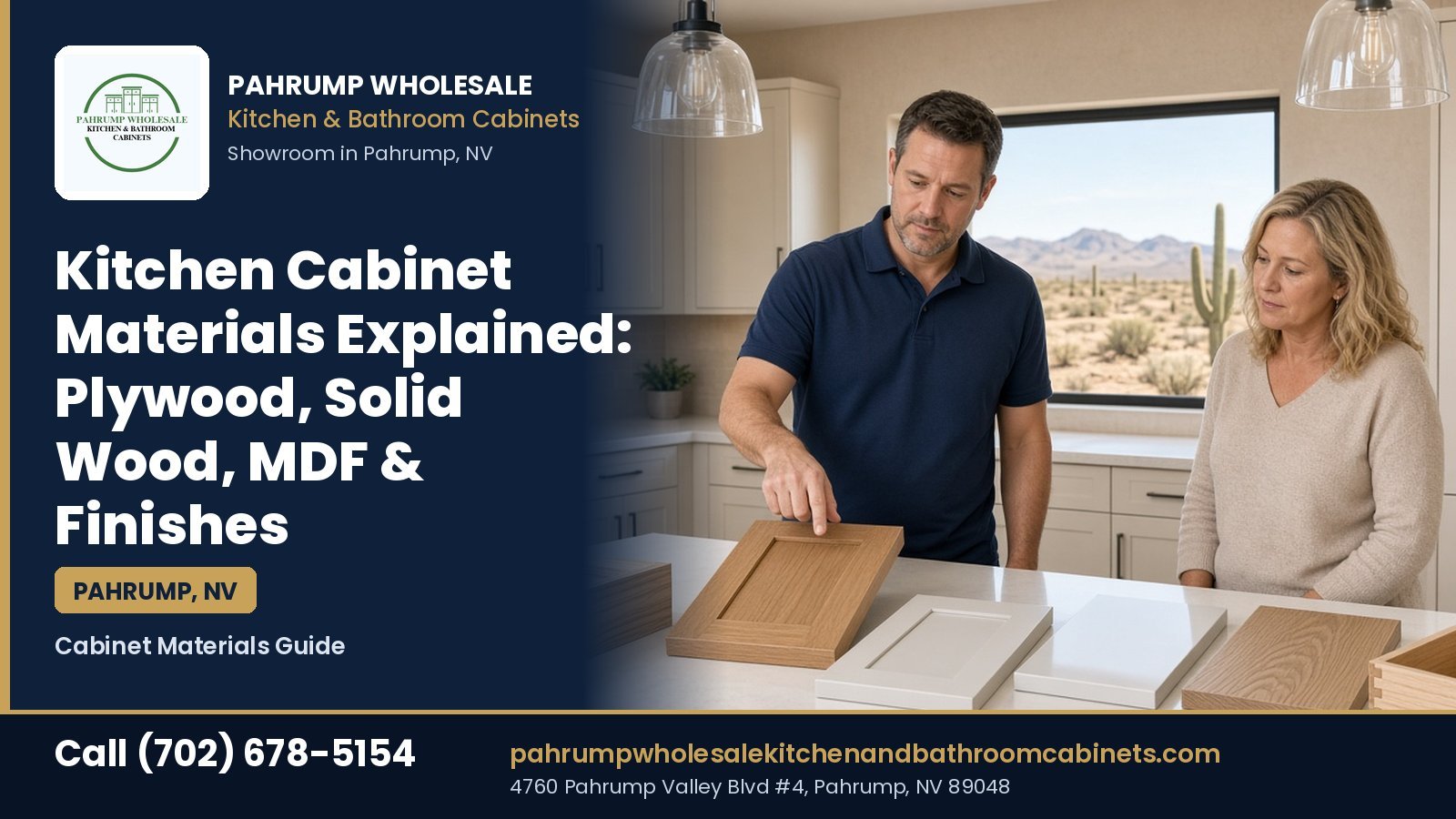
Pahrump Wholesale Kitchen and Bathroom Cabinets · Cabinet Materials Guide
Kitchen Cabinet Materials Explained: Plywood, Solid Wood, MDF & Finishes
Two cabinets can look identical on a showroom wall and be built from very different materials underneath. The box might be plywood or particleboard. The door might be solid wood, MDF wrapped in film, or a wood frame around a smooth center panel. The finish might be sprayed paint, stain, a clear coat, or a factory laminate. Those choices decide how a cabinet handles weight, water, heat, and years of daily use. This guide explains kitchen cabinet materials one by one, shows where each one is normally used in a cabinet, and walks through how the finishes on top of them behave. It also covers drawer and box joinery, how Pahrump’s dry heat and hard water affect each material, what the federal and California emission rules mean, and how to read a product spec sheet. To hold the samples and compare them side by side, visit Pahrump Wholesale Kitchen and Bathroom Cabinets at 4760 Pahrump Valley Blvd #4, Pahrump, NV 89048, or call (702) 678-5154.
Which kitchen cabinet materials should you look for, and where do they belong?
For most kitchens, look for a plywood cabinet box, plywood shelves, and plywood or solid-wood drawer boxes, because those parts carry weight and face moisture. Doors can be solid wood, a solid-wood frame with an MDF center panel, or MDF and HDF with a laminate or film surface. Then pick the finish for how you cook, clean, and live.
This page is general material guidance with educational ranges for thickness and construction, drawn from common industry practice and the store’s own product listings. It is not a price list and does not rank one line over another. Specifications change, so confirm the materials and finish of any cabinet at the showroom before you buy.
Local context: Pahrump Wholesale Kitchen and Bathroom Cabinets carries framed and frameless cabinet lines in several door materials at its Carberry Square showroom. Call (702) 678-5154 or find it on Google Maps, bring a photo of your kitchen, and ask which cabinet styles and sizes are available right now.
Where Materials Go: The Parts of a Cabinet
Quick answer: A cabinet is a box made of sides, a bottom, a top, and a back, with shelves inside, a door and drawer fronts on the outside, and drawer boxes that slide in and out. Framed cabinets add a face frame on the front of the box. Each part has a different job, so makers often use different materials for each one.
Before comparing plywood with MDF or solid wood with veneer, it helps to know which piece of the cabinet you are talking about. A sales tag that says “solid wood” may refer only to the door, while the box is something else. Asking about each part separately gives you a clear picture.
The box, also called the carcass
The box is the structure: two sides, a bottom, usually a top or top rails, and a back. It holds the shelves, carries the countertop on base cabinets, and hangs from the wall on upper cabinets. The box material matters most for strength, screw holding, and how the cabinet handles a leak under the sink. In common practice, side panels range from about 1/2 inch to 3/4 inch thick. Thicker is stiffer, but the material and the joinery matter as much as the number.
The face frame
On framed cabinets, a frame of narrow boards, usually about 3/4 inch thick, is attached to the front edge of the box. The doors hang from it, and it stiffens the opening. Face frames are usually solid wood because they need to hold hinge screws and take a clean finish on every edge. Frameless cabinets skip the face frame and hang the doors directly from the box sides, which puts more demand on the box material. The guide to framed vs frameless cabinets for Pahrump homes covers the trade-offs between the two layouts.
Doors and drawer fronts
These are the parts you see and touch most. They need to stay flat, take a finish well, and survive bumps from pots and chairs. Doors can be one solid piece (a slab), or a frame of rails and stiles around a center panel. The materials can be mixed within one door.
Shelves
Shelves carry dishes, cans, and small appliances, often for decades. A shelf that sags is one of the most common complaints about older or cheaper cabinets. Material and thickness both matter, and so does the span: a wide shelf needs to be stiffer than a narrow one.
Drawer boxes
Drawer boxes take more abuse than any other part. They are pulled open many times a day, loaded with heavy pots, and slammed shut. The sides, the bottom, and how the corners are joined all affect how long they last.
Backs, toe kicks, and end panels
The back panel keeps the box square and gives a place to screw the cabinet to the wall. The toe kick at the bottom of base cabinets sits closest to the floor and to any mop water or leaks. Finished end panels cover the exposed side of a run. Each of these may be a different material from the main box, so ask about them too.
Why mixed materials are normal
It is common, and often sensible, for one cabinet to use three or four different materials. A maker may choose plywood for the box because it holds screws, solid wood for the frame because it takes hinges and bumps, MDF for a painted panel because it stays flat, and a melamine or finished interior because it wipes clean. A mix is not a shortcut by itself. What matters is whether each material suits the job it has been given.
Plywood: The Common Choice for Cabinet Boxes
Quick answer: Plywood is made of thin wood layers glued with the grain alternating, which makes it strong, fairly light, and good at holding screws. It is widely used for cabinet boxes, shelves, and drawer boxes. Look at the thickness, the number of plies, the face grade, and how the edges are finished.
Plywood starts as thin sheets of wood, called veneers or plies, peeled or sliced from logs. The sheets are stacked with the grain of each layer turned across the one below and glued under heat and pressure. That cross-grain build resists splitting, spreads loads, and moves less with changes in humidity than solid boards.
Why cabinet makers like plywood for boxes
- Strength for its weight. Plywood carries loads well without being as heavy as most composite boards of the same thickness.
- Screw and fastener holding. Screws bite into the wood layers, so hinges, rails, and wall screws stay tight over time.
- Moisture tolerance. No wood product likes standing water, but plywood generally holds up better to a small leak than particleboard, which can swell and crumble.
- Repairability. A loosened screw hole in plywood can often be repaired and re-drilled.
Thickness
Cabinet box sides commonly run from about 1/2 inch to 3/4 inch, with shelves often at 3/4 inch for stiffness. The store’s listings for its White Oak, American Hickory, and Nature Maple Shaker lines, for example, describe a 1/2 inch Grade A cabinet-grade plywood box with 3/4 inch plywood shelves. The High Gloss listing describes a 5/8 inch A-grade plywood box and states no particle board. The Matte and Texture Finish listings describe a 3/4 inch plywood box. These are listed specifications; confirm them in the showroom for the exact cabinets you choose.
Plies and core
More plies in the same thickness usually means a flatter, more stable sheet with fewer hidden voids. Some cabinet plywood uses a hardwood veneer core, and some uses a composite core with wood faces. You can often see the layers on an exposed edge or inside a drilled hole. Ask what the core is if the spec sheet does not say.
Face grades
Hardwood plywood faces are graded by appearance, with letters such as A, B, C, and D. An A face has the fewest patches and the most even grain; lower grades allow more repairs and color variation. “Cabinet grade” is a general term rather than a single standard, so treat it as a description and ask what face grade and species are actually used.
Edges
Plywood edges show the layers. Cabinet makers cover visible edges with solid wood, a thin edge band, or the face frame itself. On frameless cabinets, edge banding on the box front is what you see when the doors open, so look at how cleanly it is applied.
Where plywood is less common
Plywood is not usually the first choice for painted slab doors, since its surface can show grain and small dips through paint. It is also not used for the center panel of most painted framed doors, for the same reason. That is where MDF comes in.
Particleboard, MDF, and HDF: The Engineered Boards
Quick answer: Particleboard, MDF, and HDF start as wood chips or fibers glued together with resin under pressure. Particleboard is the most economical and the weakest when wet. MDF is smooth and stable, which makes it good for painted doors and panels. HDF is denser still and is used for thin, tough door surfaces.
Engineered boards get a bad reputation in cabinets, but they are not all the same. Each type has places where it works well and places where it causes trouble.
Particleboard
Particleboard is made from wood chips and sawdust pressed with resin. It is flat, inexpensive, and dimensionally steady in dry conditions. Its weak points are screw holding and water. Screws can strip out of particleboard more easily than plywood, and when water gets into an unsealed edge, the board can swell and lose strength. It is often covered with a melamine or vinyl surface. Many budget cabinet lines use particleboard boxes; it is worth asking directly what the box is made of.
MDF
Medium-density fiberboard is made from fine wood fibers bonded under heat and pressure into a dense, uniform sheet with no grain. Because it has no grain and does not expand and contract the way solid wood does, it stays flat and gives a very smooth surface for paint. That is why MDF is widely used for the center panels of painted doors, for painted slab doors, and as a base for thermofoil and laminate. MDF is heavy, and its edges can swell if they are soaked, so a good sealed finish on all edges matters.
HDF
High-density fiberboard is pressed even tighter than MDF. It is harder, takes a crisp edge, and resists dents better. It is often used as the core for thermofoil and laminate doors. The store’s Matte and Texture Finish listings describe HDF thermofoil doors on frameless boxes, and the High Gloss listing gives its doors as high-density MDF finished in UV-cured PET laminate.
Melamine and coated boards
Some cabinet interiors use particleboard or MDF faced with melamine, a hard, resin-coated paper. It wipes clean easily and is common in frameless European-style boxes. The surface is durable, but chips on the edges can let water reach the core, so look at the edge banding.
Engineered boards compared
| Board | Made from | Best uses in cabinets | Main weakness |
|---|---|---|---|
| Plywood | Cross-laid wood layers | Boxes, shelves, drawer boxes | Visible layers on raw edges |
| Particleboard | Chips and sawdust with resin | Budget boxes, some shelving under melamine | Swelling when wet, weaker screw grip |
| MDF | Fine fibers with resin | Painted doors, center panels, laminate cores | Heavy; soaked edges swell |
| HDF | Densely pressed fibers | Thermofoil and laminate door cores | Heavy; hard to repair if chipped deep |
None of these boards is wrong everywhere. The question is whether each one is used in a place that suits it. MDF in a painted door panel is a smart use; particleboard in a sink base that may see a leak is a riskier one.
How to tell what you are looking at
Look at an unfinished edge, the inside of a hinge hole, or the back of the cabinet. Plywood shows layers. Particleboard shows coarse chips. MDF and HDF look like smooth, dense cardboard. Weight is another hint: an MDF door is noticeably heavier than a solid-wood door of the same size. When in doubt, ask the showroom to show you a cut sample or a spec sheet.
Solid Wood: Species and Where It Works
Quick answer: Solid wood is used for face frames, door rails and stiles, some door panels, and sometimes drawer boxes. Oak, hickory, maple, and birch are common cabinet species, each with its own grain and hardness. Solid wood is strong and repairable, but it moves with changes in humidity, which shapes how doors are designed.
“Solid wood” means boards cut directly from the tree rather than layers or fibers glued together. It is the traditional cabinet material and is still preferred for the parts that need strength at the edges and a natural look.
Common species
| Species | Look | General traits |
|---|---|---|
| Oak | Open, visible grain; white oak has a straight, linear look | Hard and sturdy; grain shows through stain and even through some paint |
| Hickory | Strong grain with big color swings from light to dark | Very hard; suits rustic and farmhouse kitchens |
| Maple | Fine, even grain, light color | Hard and smooth; popular for both stain and paint |
| Birch | Fine grain similar to maple, slightly more figure | Stable and smooth; takes paint and stain well |
| Cherry | Smooth grain, reddish tone | Softer than maple; darkens noticeably with light over time |
The store’s listings name several species. The White Oak Shaker, American Hickory Shaker, and Nature Maple Shaker pages describe 3/4 inch solid-wood doors in those species with an MDF center panel, solid-wood rails and stiles, and a 3/4 inch face frame of the same species. The Modern Gray listing gives the door and face frame as 3/4 inch solid birch, hand sprayed. The Beech Espresso listing describes a 3/4 inch solid natural maple door with an MDF center panel. These are the listed specifications; confirm them in the showroom.
Wood movement
Solid wood takes on and gives off moisture as the air changes, and it swells and shrinks across the grain as it does. A wide solid-wood panel can move enough to crack paint at its edges or open small gaps. Door makers handle this by keeping solid-wood parts narrow, letting solid-wood center panels float in a groove, or using MDF for the center panel so only the narrow frame parts are solid wood.
Hardness and dents
Harder species such as hickory and maple resist dents from dropped utensils better than softer woods. No wood is dent-proof, but a dent in a stained, grained wood is easier to hide than one in a smooth painted surface.
Solid wood or plywood for the box?
Some people assume a solid-wood box is always better. In practice, wide solid-wood panels move more with humidity than plywood, and very few cabinet lines use solid wood for full box sides. Most quality cabinets pair a plywood box with solid-wood face frames and door frames, which puts each material where it performs best. If a listing says “all wood,” ask whether that means solid wood or plywood, since both are real wood products but behave differently.
Natural color variation
Every board is different. Stained cabinets in oak or hickory will show variation from door to door. Most people see that as part of the appeal, but if you want a uniform look, a painted finish or a fine-grained species is a better fit. Look at several doors, not just one sample, to see the range. The Shaker kitchen cabinets guide shows how these species look across a full kitchen.
How Cabinet Doors Are Built
Quick answer: Most cabinet doors are either five-piece doors, with a frame of rails and stiles around a center panel, or one-piece slab doors. Five-piece doors often pair solid-wood frames with MDF or solid-wood panels. Slab doors are commonly MDF or HDF with paint, film, or laminate, or wood veneer over a stable core.
The door is the part that sets the style, but the way it is built also decides how it ages. Knowing the common constructions helps you match a door to your kitchen and your habits.
Five-piece doors
A five-piece door has four frame parts, two vertical stiles and two horizontal rails, joined at the corners around a center panel. Shaker, raised panel, and many traditional doors use this design. The frame gives strength at the edges where hinges and bumps land. The panel fills the middle.
There are three common panel choices:
- Solid-wood panel. Traditional and attractive under stain. The panel needs room to move, so it floats in a groove, and a painted door may show a thin unpainted line at the edge in dry months.
- MDF panel. Flat and stable with no movement, which helps paint stay unbroken across the panel. Many painted Shaker doors use this combination.
- Plywood or veneered panel. Used on some stained doors to show grain while staying flatter than a wide solid board.
The store’s Shaker listings describe solid-wood rails and stiles with an MDF center panel, and the Traditional Anaheim Gray and Cambridge White Raised Panel listings describe the same solid-wood frame and MDF center panel pairing.
Joints at the corners
Painted five-piece doors may show a hairline at the corner joints over time, where the rail meets the stile. That is a normal result of wood movement and not usually a structural problem. Stained doors hide it better. If a clean painted look matters a lot to you, ask how the showroom samples have aged.
Slab doors
A slab is one flat piece, common in modern and European-style kitchens. Solid-wood slabs can warp, so most slabs use a stable core: MDF, HDF, or particleboard, with paint, laminate, thermofoil, or wood veneer on the surface. The store’s High Gloss listing describes slab, full overlay doors in high-density MDF with UV-cured PET laminate; the European Cabinets page describes flat-panel doors listed as scratch-resistant, flame-retardant, non-fading, and chemical-resistant. The modern kitchen cabinets guide goes deeper on these surfaces.
Raised and recessed panels
A recessed panel sits flat inside the frame, as on a Shaker door. A raised panel is shaped so its center stands proud of the edges, which gives a more traditional look. Raised panels made from MDF can be machined in one piece with a smooth profile, which helps paint coverage.
Thickness and weight
Many cabinet doors are around 3/4 inch thick. Thicker doors feel solid but are heavier on the hinges. MDF doors weigh more than solid-wood doors of the same size, so hinge quality and adjustment matter. Ask how many hinges each tall door uses.
Glass and specialty doors
Glass doors use a frame with a glass insert instead of a panel. Some frameless lines use aluminum frames; the store’s Matte and Texture pages list aluminum frosted-glass doors and lift-up or flap doors. These have their own care needs, since the glass and frame can show fingerprints.
Veneer, Thermofoil, and Laminate Surfaces
Quick answer: Veneer is a thin slice of real wood glued over a stable core, giving a wood look with less movement. Thermofoil is a vinyl film heat-formed over MDF or HDF. Laminates, including high-pressure laminate and PET film, are tough plastic or resin surfaces. Each one resists wear differently and needs different care around heat and water.
Surfaces bonded to a core let makers combine the stability of engineered boards with the look of wood, a solid color, or a high gloss. They are widely used in frameless and modern cabinets, and in interiors of many framed lines.
Wood veneer
Veneer is real wood sliced very thin and glued to plywood, MDF, or particleboard. It shows natural grain, takes stain, and avoids the movement of wide solid boards. Veneered panels are common for cabinet sides, end panels, and flat doors. Thin veneer can be sanded through if refinished aggressively, so light touch-ups are safer than a full sand-down. The High Gloss listing describes a veneer interior on its plywood box.
Thermofoil
Thermofoil starts as a thin vinyl sheet. Heat softens it, and a vacuum press forms it tightly around a shaped MDF or HDF door. It forms a one-piece surface with no joints to crack, which makes it popular for painted-look doors at a lower cost. It wipes clean easily. Its weak point is heat: film near ovens, toasters, or coffee makers can loosen or discolor over time if there is no heat shield. Follow the manufacturer’s clearance guidance near heat sources. A lifted edge on thermofoil is hard to repair invisibly; often the door is replaced.
Laminate and PET
Laminates are layers of resin-soaked paper or plastic film pressed onto a core. High-pressure laminate is very tough and often used on countertops and commercial cabinets. PET film is a polyester surface used on many high-gloss and matte doors. It resists scratches and stains, comes in strong solid colors, and can be cured with UV light for a hard finish. On the store’s High Gloss page, that UV-cured PET surface is offered in seven listed colors, from Pure White and Off White to Midnight, Charcoal, Apple Green, Auburn Red, and Dark Scarlet.
Melamine interiors
Melamine is a thinner resin surface pressed onto board, often used for cabinet interiors. It is easy to clean and resists stains but can chip at edges.
Finished interiors
Some lines finish the inside of the box in the same color as the door rather than a natural or white surface. The Modern Gray listing describes color-matched finished interiors with “no skins necessary,” and the Beech Espresso listing describes an interior finished in the same color as the door. This matters most for glass doors and open shelving, where the inside shows.
Comparing surfaces
| Surface | Typical core | Strengths | Watch for |
|---|---|---|---|
| Wood veneer | Plywood or MDF | Real grain, stable, can be stained | Thin layer limits deep sanding |
| Thermofoil | MDF or HDF | One-piece surface, easy to wipe | Heat near appliances, edge lifting |
| PET laminate | MDF or HDF | Strong color, gloss or matte, stain resistant | Gloss shows prints; chipped edges |
| High-pressure laminate | Particleboard or MDF | Very tough surface | Visible edge lines on some designs |
| Melamine | Particleboard or MDF | Easy-clean interiors | Edge chips letting water in |
Paint, Stain, Glaze, and Clear Coats
Quick answer: Painted finishes give solid, even color and suit MDF and fine-grained woods. Stains color the wood while showing its grain. Glazes add depth in recesses. Clear topcoats protect against moisture and wear, and factory-applied, cured finishes are usually tougher than paint brushed on at home.
The finish is what you touch every day. It protects the material underneath from grease, water, and cleaning products, and it decides how easy touch-ups are later.
Paint
Painted cabinets give a clean, uniform color. They look best on smooth materials such as MDF panels and fine-grained species like maple and birch. Paint on oak still shows the open grain. Factory painting typically means multiple sprayed coats that are then cured, so the result tends to be harder than paint rolled or brushed on in the home. The Modern Gray listing describes a hand-sprayed birch door. Painted surfaces can chip at edges, and small chips are easy to touch up with a matched pen or bottle if the showroom can tell you the exact color.
Stain
Stain soaks into the wood and changes its color without hiding the grain. It suits oak, hickory, and other species where the grain is part of the look. Stained finishes hide small dents and scratches better than paint. Different boards take stain differently, so expect variation.
Glaze and specialty finishes
A glaze is a thin, tinted layer wiped over a base color so it collects in corners and profiles. It gives a raised panel or Shaker door more depth. Distressed and rubbed finishes add worn edges on purpose. These finishes are harder to touch up exactly, so keep any touch-up kit the maker offers.
Clear coats and UV finishes
Almost every cabinet finish ends with a clear protective layer. On natural-finish wood, it may be the only finish. Some finishes are cured with ultraviolet light in the factory, which hardens the coating quickly and evenly. The store’s Shaker listings describe natural-finished plywood drawers, and the Modern Gray listing describes drawers with a UV coating.
Sheen
Sheen ranges from flat or matte to satin, semi-gloss, and high gloss. Higher sheens are easier to wipe but show fingerprints and scratches; lower sheens hide marks but can hold greasy fingerprints if not cleaned regularly.
Refinishing later
Solid wood and thick veneer can be sanded and refinished. MDF can be repainted with the right primer. Thermofoil and laminate generally cannot be refinished in the same way. If you think you may want a color change in ten years, the material choice now matters. If you plan to repaint older cabinets already in the house, and the home was built before 1978, follow the EPA lead-safe renovation guidance before sanding.
Matching finish to the kitchen
Think about the parts that take the most wear. Doors and drawer fronts beside the sink, the dishwasher, and the trash pull-out get wet hands and splashes several times a day. Lower doors near the floor take kicks from shoes and bumps from vacuums. Doors around the range see grease and heat. Some homeowners choose a tougher surface or a darker color for the base cabinets and a lighter, more delicate finish for the uppers, where wear is lower. That two-tone approach can be a practical choice as well as a design one.
Choosing a finish for the way you cook
Busy family kitchens tend to favor stained wood, matte or textured surfaces, and mid-tone colors that hide wear. Quiet kitchens and those with a strong design focus may use paint or gloss. There is no single right answer; it comes down to how you use the room and how much upkeep you want.
Drawer Boxes, Joints, and How the Box Is Assembled
Quick answer: Materials only perform as well as the way they are joined. Look for plywood or solid-wood drawer boxes with dovetail or similarly strong corners, a drawer bottom set into a groove, and a box held together with glue plus mechanical fasteners. Frameless and ready-to-assemble boxes often use cam locks, which work well when tightened properly.
Two cabinets built from the same plywood can feel very different if one is glued and screwed and the other is only stapled. Joinery is where a lot of quality hides.
Drawer box materials
Drawer boxes are commonly made from plywood, solid wood, particleboard with a melamine face, or metal. Plywood and solid wood hold up well to heavy loads and repeated slamming. The store’s Shaker and Traditional listings describe 5/8 inch plywood dovetail drawers with a natural finish, the Modern Gray listing describes 5/8 inch natural-finish drawers with UV coating and dovetail joints, and the High Gloss listing describes 5/8 inch dovetail drawers. Confirm these details on the exact cabinets you choose.
Dovetail joints
A dovetail joint uses interlocking, fan-shaped pins and tails at the corner of a drawer box. The shape resists being pulled apart in the direction a drawer is pulled every day. It is a traditional sign of careful drawer construction. Other joints, such as dowels or rabbets with screws and glue, can also be strong; stapled butt joints are the weakest.
Drawer bottoms
A drawer bottom set into a groove on all four sides is stronger than one stapled to the underside. Heavier bottoms resist sagging under pots and cans. Pull a drawer out and look underneath.
Box assembly
Assembled cabinet boxes are joined with some mix of glue, staples, screws, dowels, dadoes (grooves that panels slide into), and brackets. The Modern Gray listing describes staple-and-glue box construction with L brackets for the face frame. Frameless and ready-to-assemble boxes often use metal cam locks, which pull panels tight when turned; the High Gloss listing describes a steel cam-lock system and the Matte and Texture listings describe cam lock assembly. Cam locks work well when panels are aligned and tightened fully, and they can be retightened if a cabinet loosens. The guide to RTA vs assembled cabinets explains how the assembly method affects install time.
Corner blocks and rails
Base cabinets often have corner blocks or rails at the top to hold the box square and give the countertop installer something to fasten to. Look for them when you look inside a base cabinet.
Hinges and slides
Hinges and drawer slides are hardware rather than materials, but they depend on the material they are screwed into. Plywood and solid wood hold hinge screws firmly. Many current lines use concealed, adjustable hinges and undermount soft-close slides. The store’s Shaker listings describe soft-close doors and drawers on undermount rails, and the High Gloss listing describes 6-way adjustable hinges with undermount full-extension soft-close glides. The Matte and Texture listings mention 3D front adjustment.
Quick checks you can do
- Open a drawer all the way and look at the corners and the bottom.
- Look inside the box at the back corners and the bottom edge.
- Press on a shelf in the middle to see if it flexes.
- Check the edges of doors and boxes for clean banding or finish.
- Lift a door off its hinges, if the showroom allows, to feel its weight.
For a fuller list of checks covering the whole cabinet, see this cabinet quality checklist.
Want to Feel the Difference Between Plywood, MDF, and Solid Wood?
Materials are easier to judge in your hands than on a screen. At the Carberry Square showroom you can lift a door to feel its weight, look inside a cabinet box at the edges and back, pull a drawer out to see how the corners are joined, compare painted, stained, and laminate samples side by side, and ask which cabinet styles and sizes are available right now. Bring photos of your kitchen and any finish samples you already have. The showroom is at 4760 Pahrump Valley Blvd #4, Pahrump, NV 89048.
How Each Material Handles Pahrump’s Heat, Dry Air, and Hard Water
Quick answer: In a hot, dry desert climate, solid wood can shrink slightly and show gaps, films and laminates can loosen near strong heat, and hard water leaves spots that wear finishes if left. Plywood boxes, stable door cores, sealed edges, and a regular wipe-down help every material last longer.
Pahrump sits in the Mojave Desert, with long hot summers, cool winters, low humidity most of the year, and strong sun. Regional climate notes from the Las Vegas forecast office of the National Weather Service describe how dry and hot it stays for much of the year. Inside an air-conditioned home, the swings are smaller, but they still affect cabinets.
Solid wood in dry air
Wood gives up moisture in very dry air and shrinks slightly across the grain. On a five-piece door, that can show as a thin line at the edge of a floating panel or a hairline at a painted corner joint. It is usually cosmetic. Keeping indoor humidity reasonably steady and avoiding blowing hot or cold air straight onto cabinets helps. Doors with MDF center panels show less of this, since only the narrow frame parts move.
Engineered boards and moisture
Dry air is easy on MDF and particleboard. Their enemy is water: a slow leak under the sink, a dishwasher that drips, or a mop left against the toe kick. In a dry climate, small leaks can go unnoticed because the water evaporates before it spreads, while still soaking into a board edge. Check the sink base and the area around the dishwasher every few months. Plywood generally tolerates a short wetting better than particleboard.
Heat and films
Thermofoil and some laminate surfaces can soften, discolor, or lift when exposed to strong, repeated heat. In a kitchen, the risk comes from ovens, toasters, air fryers, and coffee makers parked under upper cabinets, more than from the outdoor climate. Use heat shields where the maker recommends them, leave room above countertop appliances, and do not let steam vent directly onto a door edge.
Sunlight
Strong sun through a window can fade some stains and change the tone of some woods over time; cherry, for example, darkens. Painted and laminate finishes vary in how they resist fading. The European Cabinets page lists non-fading as one of its flat-panel door traits. Window film or shades help if a run of cabinets sits in direct afternoon sun.
Hard water and dust
Hard water leaves white mineral spots on doors near the sink and dishwasher. If those spots are left and scrubbed later with abrasive cleaners, they can dull a finish. Wipe splashes with a soft, damp cloth and dry the surface. Dust is common in the desert and settles in the profiles of raised panel and Shaker doors; a soft brush or microfiber cloth handles it. Smooth slab doors and textured surfaces each have their own advantages here: slabs are quick to wipe, and textures hide fine dust between cleanings.
Before installation
Cabinets stored in a hot garage or a closed shed in July can take on heat and lose moisture before they are ever installed. When possible, keep boxed cabinets inside the conditioned part of the house for a short time before installation so they settle to the room’s conditions. Ask your installer what they recommend for the specific line. Store boxes flat and off concrete floors, and keep doors in their packaging until they are hung to protect the finish.
Material choices for desert kitchens
- Box: plywood is a sensible choice, especially for the sink base.
- Doors: solid-wood frames with MDF panels, or MDF and HDF cores with a durable surface, stay flat in dry air.
- Finish: factory-cured paint, stain with a clear topcoat, or UV-cured laminate all work; pick for your cleaning habits.
- Edges: look for fully sealed edges on every door and panel.
The guide to common kitchen cabinet problems in Pahrump homes shows what wear usually looks like after years of use.
Signs a material is struggling
Catching problems early keeps them small. Look for these signs a few times a year, especially around the sink, the dishwasher, and the range:
- Swollen or soft edges on the bottom of the sink base or toe kick, which point to water reaching an engineered board.
- Bubbles or lifting film on thermofoil doors near heat sources.
- Peeling edge banding on frameless boxes or shelves.
- Doors that no longer line up, which may mean a hinge screw has loosened or the box has shifted.
- Dull patches on finishes near the sink from hard-water spots and scrubbing.
Most of these can be fixed if found early: tightening hinges, regluing banding, drying out a leak and replacing a bottom panel. Leaving them usually means replacing a full door or cabinet later.
Caring for each material
| Surface | Everyday cleaning | Avoid |
|---|---|---|
| Painted wood or MDF | Soft damp cloth, mild soap, dry after | Scouring pads, ammonia cleaners |
| Stained wood | Damp cloth, dry after; occasional wood-safe cleaner | Soaking wet rags, oil soaps left to build up |
| Thermofoil | Damp cloth, mild soap | Heat sources, harsh solvents |
| Gloss or matte laminate | Microfiber cloth, mild soap | Abrasive powders, rough sponges |
| Melamine interiors | Damp cloth | Standing water on chipped edges |
Always follow the manufacturer’s care instructions for the specific finish, since some coatings have their own requirements.
Emission Rules, Certifications, and What the Labels Mean
Quick answer: Plywood, MDF, and particleboard are bonded with resins that can release formaldehyde. Federal rules under the EPA, and California’s rules under CARB, set emission limits for these composite wood products and require labeling. Industry programs such as KCMA certification test cabinets for structure and finish performance.
Most cabinets contain some composite wood, even when the doors are solid wood. That makes emission rules relevant to almost every kitchen.
Federal formaldehyde standards
The EPA’s formaldehyde emission standards for composite wood products, under Title VI of the Toxic Substances Control Act, set limits for hardwood plywood, MDF, and particleboard sold, supplied, or made in the United States. Covered products and finished goods that contain them must be labeled as compliant. On cabinets, the label may be on the cabinet itself or on its packaging.
California’s program
California’s Air Resources Board runs its own composite wood products program, which the federal rule was modeled on. You may see “CARB Phase 2” on labels. Many manufacturers label for both programs, since products sold in California must meet CARB rules.
KCMA certification
The Kitchen Cabinet Manufacturers Association offers a voluntary certification in which sample cabinets go through industry-standard tests covering load strength, how doors and drawers hold up to repeated use, and how well the finish resists wear and moisture. It also has a separate environmental program. Certification is voluntary, and plenty of uncertified cabinets are well made. Still, the program gives you a defined benchmark to ask about.
Finishes and indoor air
Paints, stains, and clear coats can also release volatile organic compounds while they cure. Factory finishes are usually applied and cured well before cabinets reach a home, which is one reason they tend to have less odor at installation than cabinets painted on site. If you plan to paint or touch up cabinets yourself, choose a low-VOC product and ventilate the room while you work.
Questions to ask
- Do the composite wood parts carry a TSCA Title VI or CARB Phase 2 compliance label?
- Is the cabinet line certified by KCMA or another testing program?
- What finish is used, and is it cured in the factory?
Airing out a newly installed kitchen for a few days, with windows open when the weather allows, is common practice with any new furniture or cabinetry.
How to Read a Cabinet Spec Sheet
Quick answer: Read a spec sheet part by part: door material and panel, face frame, box material and thickness, shelves, drawer box and joints, hinges and slides, finish, and interior. Note anything missing and ask about it. Then confirm the details on a real cabinet at the showroom.
Product pages and spec sheets pack a lot into a short list. Here is how to translate the common lines, using wording similar to what appears on the store’s own listings.
| Spec line | What it means | What to ask |
|---|---|---|
| 3/4″ solid wood door with MDF center panel | Solid-wood rails and stiles around a smooth, stable panel | Which species is the frame? |
| 3/4″ face frame, same species | A solid-wood frame on the box front matching the door | Is it glued, screwed, or bracketed? |
| 1/2“ or 5/8” plywood box | Box sides of plywood at that thickness | Is the back and bottom also plywood? |
| 3/4″ plywood shelves | Thick, stiff shelves that resist sagging | Are they adjustable? |
| 5/8″ dovetail drawers | Drawer sides of 5/8″ material with dovetail corners | What are the sides made of? |
| Soft-close undermount slides | Hidden slides under the drawer that slow it as it shuts | Full or partial extension? |
| UV-cured PET laminate | A polyester surface hardened with UV light | How are edges finished? |
| HDF thermofoil door | Vinyl film over dense fiberboard | Is a heat shield needed by the range? |
| Cam lock assembly | Panels joined with metal cam fittings | Shipped flat or assembled? |
| Finished interior | Inside surfaces color-matched or finished, not raw | Same color as doors or neutral? |
A part-by-part question list
- Door: solid wood, MDF, HDF, or a mix? What surface or finish?
- Face frame: which species and thickness, and how is it attached?
- Box sides, bottom, and back: which material and thickness for each?
- Shelves: thickness and whether they are adjustable.
- Drawer boxes: material, joint type, and how the bottom is fitted.
- Hardware: hinge type, slide type, and soft-close on doors and drawers.
- Interior: natural, white, or color-matched finish.
- Labels: any emission compliance or certification marks.
Watch for vague terms
“Wood construction,” “all wood,” “furniture grade,” and “cabinet grade” sound reassuring but do not say which material is used where. Ask for the specific material and thickness of each part.
Missing lines
If a spec sheet lists the door and box but says nothing about the back, the bottom, or the drawer box, ask. The parts left off are sometimes the ones made from a cheaper material.
Compare like with like
When comparing two lines or two quotes, write each part side by side: door, frame, box, shelves, drawers, hardware, finish. Differences in price often trace back to one or two parts. The guide to comparing cabinet quotes in Pahrump uses the same item-by-item method.
Materials for other rooms
The same materials appear in cabinets throughout the house, but each room asks something different of them.
- Bathrooms: steam and splashes make sealed edges and a plywood sink base especially worthwhile.
- Laundry rooms: washers can leak, so the base cabinets beside them face the same risk as a kitchen sink base.
- Garages: heat in a Pahrump garage can be extreme in summer, so films and some finishes may not suit an unconditioned space. Ask before choosing kitchen cabinets for a garage.
- Wet bars and outdoor kitchens: standard indoor cabinets are not built for outdoor use. Covered patios still see heat, dust, and sun.
- Pantries and closets: lighter loads and little moisture make these good places to save on materials if your budget is tight.
Putting it together
A practical material plan might look like this: plywood boxes throughout, with extra attention to the sink base; solid-wood face frames and door frames with MDF panels for a painted Shaker look, or a laminate slab for a modern look; dovetail plywood drawers on soft-close slides; and a factory-cured finish chosen for how you clean. That is a description of common good practice, not a recommendation for one specific line. Compare it with what each cabinet you see actually uses.
Take samples home
If the showroom offers a sample door, take it home and set it next to your floor, countertop sample, and wall paint. Look at it in morning and evening light, wipe it with a damp cloth, and see how it handles a fingerprint. A sample tells you how a material looks in your own kitchen, which a spec sheet cannot. The European Cabinets page mentions a sample door, so ask what is available for the lines you are considering.
Bring it to the showroom
Spec sheets help, but the real test is opening a cabinet. Bring your notes, look at the edges, drawers, and backs, and ask the staff to point out each listed material on a display. Kitchen designers certified through organizations such as the National Kitchen & Bath Association also work with these spec sheets every day if you are using a designer for your remodel.
If your project also includes a bathroom, the same material questions apply to vanities, where moisture makes the box and edge details even more important. The bathroom vanity cabinets guide covers sizing and storage for that room.
Pahrump Wholesale Kitchen and Bathroom Cabinets
Pahrump Wholesale Kitchen and Bathroom Cabinets serves homeowners, builders, remodelers, and rental owners in Pahrump and around Nye County from its showroom in Carberry Square. Its product pages list framed solid-wood lines alongside frameless laminate and thermofoil lines, so you can compare boxes, drawers, and door surfaces in one visit and ask which cabinet styles and sizes are available right now.
- Address: 4760 Pahrump Valley Blvd #4, Pahrump, NV 89048
- Phone: (702) 678-5154
- Email: info@pahrumpwholesalekitchenandbathroomcabinets.com
- Showroom: Pahrump kitchen cabinets showroom
- About: About the store
- Contact: Contact us
- Maps: Google Maps listing
A material is much easier to judge when you can see its edge and feel its weight, so plan to compare samples in person before you decide.
Frequently Asked Questions About Kitchen Cabinet Materials
Is plywood or particleboard better for kitchen cabinet boxes?
Plywood is generally the stronger choice for cabinet boxes. Its cross-laid wood layers hold screws firmly, carry loads well for their weight, and tolerate a small leak better than particleboard, which can swell when its edges get wet. Particleboard costs less and stays flat in dry conditions. If you are choosing where to spend, a plywood sink base is a sensible priority.
Is MDF a bad material for cabinets?
No. MDF is a good material in the right place. It is smooth, has no grain, and stays flat, which makes it well suited to painted doors, center panels, and as a core for laminate or thermofoil. Its weaknesses are weight and swelling if an edge is soaked. MDF works best when every edge is sealed and it is kept away from standing water.
What does solid wood door with MDF center panel mean?
It describes a five-piece door. The outer frame, two rails and two stiles, is solid wood, and the flat panel in the middle is MDF. The frame gives strength where hinges attach and edges get bumped, while the MDF panel stays flat and keeps paint from cracking as the wood moves. Many painted Shaker and raised panel doors are built this way.
Are solid wood cabinets better than plywood cabinets?
Not always. Wide solid-wood panels move with humidity more than plywood, so most quality cabinets use plywood for the box and solid wood for face frames and door frames. That puts each material where it performs best. If a listing says all wood, ask whether it means solid wood, plywood, or both, and which parts use each one.
What is the difference between MDF and HDF?
Both are made from wood fibers and resin pressed into sheets. HDF is pressed to a higher density, so it is harder, more dent resistant, and takes a crisp machined edge. It is often used as the core of thermofoil and laminate doors. MDF is slightly lighter and very common for painted doors and panels. Both need sealed edges to resist moisture.
What is thermofoil and how long does it last?
Thermofoil is a vinyl film heated and vacuum-pressed over an MDF or HDF door. It gives a smooth, joint-free surface that is easy to wipe. Lifespan depends on care and placement. The main risk is heat: film near ovens, toasters, or coffee makers can loosen or discolor. Following the maker’s heat-shield and clearance guidance helps thermofoil doors last.
What is PET laminate on cabinet doors?
PET is a polyester film bonded to a door core, often MDF or HDF. It comes in gloss and matte finishes and strong solid colors, resists stains and scratches, and is easy to clean. Some PET surfaces are cured with ultraviolet light for extra hardness. The store’s High Gloss page lists this surface over high-density MDF doors.
Which wood species is best for painted cabinets?
Fine-grained, smooth woods such as maple and birch take paint well because the grain does not show through. MDF panels are also popular for painted doors. Oak has an open grain that remains visible under paint, which some people like and others do not. Look at a painted sample in each species under your kitchen lighting before you choose.
Why are dovetail drawers considered a sign of quality?
A dovetail joint locks the front and sides of a drawer box together with interlocking, fan-shaped pins and tails. The shape resists being pulled apart in the same direction a drawer is pulled every day. It shows careful construction. Other joints, such as dowels with glue and screws, can also be strong, while stapled butt joints are the weakest option.
How does Pahrump’s dry climate affect wood cabinets?
Very dry air pulls moisture out of solid wood, which shrinks slightly across the grain. On five-piece doors that can show as a thin line at a floating panel or a hairline at painted corner joints. It is usually cosmetic. Keeping indoor humidity steady, not blowing vents directly at cabinets, and choosing doors with MDF center panels all reduce it.
Do cabinets give off formaldehyde?
Composite wood such as plywood, MDF, and particleboard is bonded with resins that can release small amounts of formaldehyde. Federal rules under TSCA Title VI and California’s CARB program set emission limits for these products and require labeling. Ask whether the cabinets carry a compliance label, and air out a newly installed kitchen for a few days when weather allows.
What does KCMA certified mean for kitchen cabinets?
KCMA is the Kitchen Cabinet Manufacturers Association. Its certification puts sample cabinets through industry-standard tests for load strength, repeated door and drawer use, and finish resistance. It is voluntary, so a cabinet without the seal is not automatically poor. Certification gives you a defined benchmark, and it is a reasonable question to ask when comparing cabinet lines.
Can I paint or refinish my cabinets later?
It depends on the material. Solid wood and thicker veneer can be sanded and refinished. MDF and factory-painted surfaces can usually be repainted with the right primer. Thermofoil and laminate generally cannot be refinished the same way. If you might change colors in the future, keep that in mind now. For homes built before 1978, follow lead-safe practices when sanding old paint.
Which cabinet material is best for a sink base?
The sink base faces more water than any other cabinet, from leaks, drips, and wet cleaning supplies. Plywood is a sensible material for that box because it generally handles a short wetting better than particleboard. A sealed bottom, a drip tray or liner, and checking the plumbing every few months all help, whatever the cabinet is made of.
Where is Pahrump Wholesale Kitchen and Bathroom Cabinets located?
Pahrump Wholesale Kitchen and Bathroom Cabinets is at 4760 Pahrump Valley Blvd #4, Pahrump, NV 89048, in Carberry Square. Call (702) 678-5154 or open the Google Maps listing for directions. Homeowners across Pahrump and nearby Nye County can compare door samples side by side, look inside cabinet boxes and drawers, bring photos of the kitchen, and ask which cabinet styles and sizes are available right now. Written questions can go through the contact page.
Find Pahrump Wholesale Kitchen and Bathroom Cabinets
View Pahrump Wholesale Kitchen and Bathroom Cabinets on Google Maps
Pick Materials That Match How You Use Your Kitchen
Good cabinets put each material where it works best: a sturdy box, stable doors, strong drawer joints, and a finish that suits how you cook and clean. Ask what each part is made of, look at the edges and drawers yourself, and keep Pahrump\’s heat, dry air, and hard water in mind. Call Pahrump Wholesale Kitchen and Bathroom Cabinets at (702) 678-5154, bring your kitchen photos to the Carberry Square showroom, and ask which cabinet styles and sizes are available right now.
4760 Pahrump Valley Blvd #4, Pahrump, NV 89048 · Carberry Square · Serving Pahrump & Nye County