
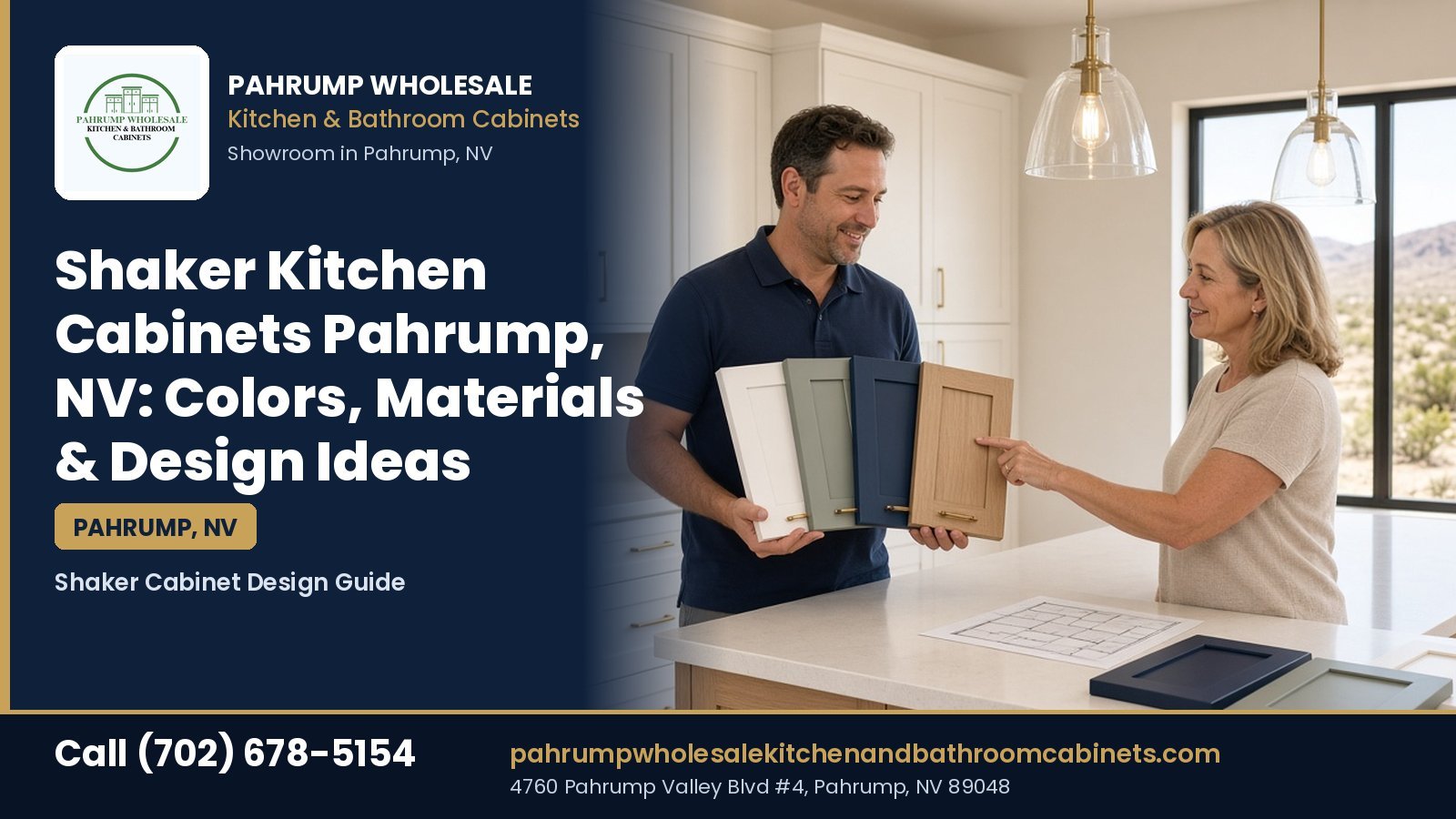
Pahrump Wholesale Kitchen and Bathroom Cabinets · Shaker Cabinet Design Guide
Shaker Kitchen Cabinets Pahrump, NV: Colors, Materials & Design Ideas
A shaker door is about as simple as cabinetry gets: four flat boards framing a recessed panel. That simplicity is why it shows up in so many kitchens, from a manufactured home off Homestead Road to a new build on the north end of the valley. It is also why two shaker kitchens can look and age so differently. The wood species in the frame, the material in the center panel, the type of finish, the color you pick, and the light coming through your windows all change the result. This guide looks at shaker kitchen cabinets in Pahrump from the inside out. It explains how the door is built, what the materials listed on real product pages mean, how paint and stain behave in dry desert air, which colors suit which rooms, and a set of design ideas you can adapt to your own floor plan. It also covers what to check with your hands in a showroom and the myths worth ignoring. To see shaker doors in person, visit Pahrump Wholesale Kitchen and Bathroom Cabinets at 4760 Pahrump Valley Blvd #4, Pahrump, NV 89048, or call (702) 678-5154.
What should Pahrump homeowners know before choosing shaker kitchen cabinets?
Shaker cabinets use a five-piece door: a frame of solid rails and stiles around a recessed center panel. Look at what the frame and panel are made of, choose paint or stain based on how much hairline movement and fading you can accept, test colors in your own light, and check the box, drawers, and finish quality before you choose a line.
This page explains general construction, materials, finishes, and design choices for shaker cabinets, with educational ranges of what to expect from typical residential work. It is not a price list and not a quote from Pahrump Wholesale Kitchen and Bathroom Cabinets. Product specifications can change, so confirm the current details of any line in person before you order.
Local context: Pahrump Wholesale Kitchen and Bathroom Cabinets sells kitchen and bathroom cabinets to homeowners across Pahrump and Nye County from its Carberry Square showroom. Its website lists more than a dozen shaker door lines. Call (702) 678-5154 or find the showroom on Google Maps, and ask which cabinet styles and sizes are available right now.
How a Shaker Cabinet Door Is Built
Quick answer: A shaker door has two vertical stiles, two horizontal rails, and a flat center panel set into a groove so it sits slightly below the frame. The inside edge of the frame is square, with no curved profile. Everything else, from the wood species to the width of the frame, varies from one line to the next.
The name comes from the Shakers, a religious community in early America whose furniture was known for plain, useful forms with very little ornament. The cabinet door that carries their name follows the same idea. There is no raised panel, no arched top, and no routed edge. A flat panel sits inside a flat frame, and the shadow line between them is the only decoration.
Because the design is so plain, small differences in proportion and build stand out more than they would on a busier door. A shaker door with crisp, tight joints and an even shadow line looks expensive. One with gaps at the corners, a panel that rattles, or paint pooled in the inside edge looks cheap, even from across the room.
The five pieces
Stiles run top to bottom on the left and right. Rails run side to side across the top and bottom. On tall pantry doors you may also see a middle rail, which splits the door into two panels and helps keep a long door flat. The center panel fits into a groove cut along the inside edge of all four frame pieces. When people talk about a “five-piece door,” they mean these four frame parts plus the panel.
How the corners are joined
Most manufactured shaker doors use a cope-and-stick joint, where the end of each rail is shaped to lock into the profile of the stile, then glued. Some higher-end doors use mortise-and-tenon joints, which have a longer glue surface. Either can last for decades in a kitchen if it is cut accurately and glued well. What you care about as a buyer is the result: the joint should be flush on the face, with no step you can catch with a fingernail, and it should not flex when you press on the rail.
Frame width and the slim shaker look
The width of the rails and stiles changes the character of the door more than most people expect. A standard shaker frame reads as classic and a little traditional. A narrow frame, often sold as a slim shaker, reads lighter and more modern, and it pairs well with bar pulls and flat countertops. The showroom’s Slim White Shaker line is an example of the narrower look. Wide frames can feel heavy on small upper cabinets, while very narrow frames can look busy on a long run of drawers, so it helps to see both on full-size boxes before you choose.
Recess depth and shadow line
The recessed panel is what gives shaker its depth. A deeper step casts a darker shadow, which shows up clearly in photos and in strong side light. A very shallow step can make the door look almost flat at a distance. Neither is wrong. If you love a crisp, graphic look, a pronounced shadow line helps. If you want a quieter kitchen, a softer step is easier to live with and easier to wipe clean.
Where shaker sits among other door styles
Shaker sits between raised-panel traditional doors and flat slab modern doors, which is why it is often described as transitional. If you are still deciding between shaker, slab, frameless, and custom, the cabinet styles comparison for Pahrump homes covers that decision. This guide assumes you have already leaned toward shaker and want to get the details right.
| Door feature | What it is | What to look for |
|---|---|---|
| Stiles | Vertical frame pieces on each side | Straight, flush with the rails, consistent width door to door |
| Rails | Horizontal frame pieces top and bottom | Tight joints with no visible gap or step |
| Center panel | Flat panel set in a groove | Sits flat, does not rattle, finish reaches the edges |
| Inside edge | Square step between frame and panel | Clean, even finish with no pooling or bare spots |
| Mid rail | Extra rail on tall doors | Lines up with neighboring doors when cabinets sit side by side |
Shaker Frame, Panel, and Box Materials Explained
Quick answer: Most quality shaker doors pair a solid wood frame with an MDF center panel. The wood species changes how the door takes paint or stain. Behind the door, the box, shelves, and drawers matter just as much, so read the full specification list for any line, not only the door.
Shaker doors look alike in photos, but the material list behind them can vary a lot. The product pages on the Pahrump Wholesale Kitchen and Bathroom Cabinets site are useful here because they list the construction for each door line. The examples below come from those pages. Treat them as a starting point and confirm current specifications in the showroom, because manufacturers can change materials between production runs.
Solid wood frames
The frame takes the knocks, holds the hinges, and carries the joints, so solid wood is the usual choice. Common species for shaker frames include maple, birch, oak, and hickory. Each behaves a little differently:
- Maple has a fine, tight grain that paints smoothly and takes stain evenly. The Catalina White Shaker and Ice White Shaker pages list solid European maple rails, stiles, and face frames. Nature Maple Shaker uses a natural maple door and face frame.
- Birch is similar to maple in hardness, with a little more visible figure. The Ashton Gray Shaker and Rustic Gray Shaker pages list a 3/4-inch solid birch door and face frame with a hand-sprayed gray stain.
- Oak has an open, pronounced grain that stays visible under stain and can telegraph through paint. The White Oak Shaker page lists a 3/4-inch American oak door and face frame with an MDF center panel.
- Hickory is hard and shows strong color variation from pale to dark within the same door. The American Hickory Shaker page lists a 3/4-inch American hickory door and face frame with an MDF center panel.
Why the center panel is often MDF
A lot of buyers assume an MDF center panel is a shortcut. In shaker doors it is usually a deliberate choice. Solid wood expands and contracts across its width as humidity changes. A wide solid wood panel has to float loose in its groove so it can move, and in very dry air it can shrink enough to show a thin strip of unfinished wood along the edge. MDF moves very little, so it stays put, holds paint smoothly, and does not open those strips. Most of the painted shaker lines on the store’s product pages list an MDF center panel inside a solid wood frame, including the Classic White Shaker.
MDF has weaknesses too. It does not like standing water, and a deep gouge cannot be sanded out the way solid wood can. On a stained door, an MDF panel needs a wood veneer face to match the frame. When you look at a stained shaker door, check that the panel grain looks like real wood and that the color matches the frame closely.
The box behind the door
Doors are what you see, but the box is what holds the countertop and the dishes. For the shaker lines on the store’s site, the listed box construction is fairly consistent: a 1/2-inch cabinet-grade plywood box, 3/4-inch cabinet-grade plywood shelves, and 5/8-inch plywood drawer boxes with dovetail joints and soft-close undermount rails. Several lines also list a finished interior in the same color as the door, and the gray stained lines mention color-matched exteriors, so the exposed side of an end cabinet does not need a separate skin panel.
When you compare lines from any seller, put these details side by side. Plywood holds screws well and resists sagging. Particleboard is common in lower-cost boxes and is more sensitive to water at the sink base. A finished interior is easier to wipe out and looks better behind glass doors. For a broader checklist that applies to every cabinet style, see how to tell if kitchen cabinets are good quality.
Framed boxes and overlay
Most shaker lines are built on a framed box, with a face frame on the front of the cabinet that the hinges attach to. The doors may cover most of that frame (full overlay) or leave some of it showing (partial overlay). Full overlay looks cleaner and more current. Partial overlay has a more traditional look. A few shaker doors are also made for frameless boxes. The difference between those two box systems is explained in the guide to framed vs frameless cabinets.
| Material | Where it is used | Strengths | Watch for |
|---|---|---|---|
| Solid maple or birch | Frames, face frames | Hard, smooth, paints and stains well | Hairlines at painted joints in dry air |
| Solid oak | Frames, face frames | Strong grain under stain, very durable | Grain texture shows through paint |
| Solid hickory | Frames, face frames | Very hard, lots of natural character | Wide color variation from door to door |
| MDF | Center panels | Stable, smooth, holds paint evenly | Damage from standing water at the edges |
| Cabinet-grade plywood | Boxes, shelves, drawers | Holds fasteners, resists sagging | Edge quality and veneer face on shelves |
Formaldehyde and composite wood
MDF and plywood are composite wood products, which means they use resin binders. In the United States, composite wood used in cabinets is covered by federal emission standards. The EPA explains the rules on its page about formaldehyde emission standards for composite wood products, and California’s program is described by the California Air Resources Board. If this matters to your household, ask to see the compliance label or paperwork for the line you are considering.
Painted vs Stained Shaker Cabinets
Quick answer: Paint gives shaker its crisp, solid-color look but shows hairline lines at the frame joints as wood moves. Stain lets the wood grain show, hides small dings better, and can shift in color under strong sun. Pick based on the look you want and the kind of wear you are willing to accept.
Shaker doors come in three broad finish types: solid paint, stain over visible grain, and stain or glaze that adds depth to a painted color. Each one ages differently, and the desert makes those differences easier to notice.
Painted shaker
Painted shaker is the look most people picture first: a white or soft-colored door with an even, smooth surface. Factory paint is usually sprayed in several coats and cured, which gives a harder, more even finish than brushing paint on at home. On product pages you will see phrases like hand sprayed, which describes how the finish is applied.
The trade-off is the joint line. A painted door has one continuous film of paint across the frame, but the wood underneath is four separate pieces. When humidity drops sharply, as it does through much of the Pahrump year, the wood shrinks a tiny amount and the paint can show a hairline where a rail meets a stile. This is normal wood movement in a solid frame. It does not mean the door is failing, and it usually does not spread. It is more visible on dark paint than on white, and more visible on doors near heat sources like the range or dishwasher vent.
Stained shaker
Stain soaks into the wood and is sealed under a clear topcoat. The grain shows, and a small scratch or ding blends into the natural variation more easily than on a solid painted door. Stained frames still move, but there is no continuous paint film to crack, so joint lines are much less noticeable.
The weak spot for stain is sunlight. Wood darkens, ambers, or fades over years of UV exposure, depending on the species and the finish. A stained door next to a west-facing window can drift away from the color of a door in a shaded corner. Window film, shades, or simply placing the stained pieces away from direct afternoon sun all help.
Glazed and toned finishes
Some lines add a glaze or a toned stain over a base color to give depth in the inside corners and grain. The Ashton Gray and Rustic Gray lines are described as gray shaker stained doors, which sit between a solid paint and a natural wood look. Glazed finishes can hide dust in the inside edge better than flat white, but they make touch-ups harder to blend, so ask whether a matching touch-up product exists for the line.
| Finish | Look | Hides well | Shows more | Good fit |
|---|---|---|---|---|
| Light paint | Clean, bright, even | Hairlines at joints, light dust | Scuffs from shoes and pets on base doors | Small or dark kitchens that need brightness |
| Dark paint | Bold, graphic | Scuffs and stains | Joint hairlines, fine dust, fingerprints | Accent islands and bars |
| Natural or light stain | Warm, grain-forward | Dings, everyday wear | UV color shift near windows | Busy family kitchens, mixed-material designs |
| Gray stain or glaze | Soft, textured color | Dust in corners, small marks | Touch-ups that do not blend | Homes that want color without flat paint |
Touch-ups: Before you order, ask whether the line has a matching touch-up product and how the finish should be repaired. Painted shaker doors are easy to scratch during installation, and having the right color on hand is much easier than trying to match it later.
Shaker Cabinet Colors and How They Read in Pahrump Light
Quick answer: Shaker colors fall into five families: bright whites, soft off-whites and greiges, grays, dark tones, and natural wood. The recessed panel creates a shadow line that makes every color look a little deeper on the door than on a flat chip, so judge shaker colors on a real door sample in your own room.
A color guide for flat paint chips does not tell the whole story for shaker cabinets. The frame and panel catch light at different angles, so the same color reads lighter on the frame and darker in the recess. White shaker can show a faint gray line in every inside corner. A dark shaker door can look almost black on the panel and a shade lighter on the frame. That variation is part of the appeal, but it means you should judge color on a door, not a swatch. For a color-first look at every cabinet style, including trends for the year, see the guide to kitchen cabinet colors for Pahrump homes. The notes below focus on how each family behaves on a shaker door.
Bright whites
White shaker is the most requested version of the style for a reason. It brightens small kitchens, pairs with almost any countertop, and reads clean in listing photos. The product range on the store’s site includes several whites, such as Classic White, Ice White, Catalina White, and Slim White. They are not identical. Some whites lean cool and slightly blue, others lean warm and creamy, and that difference becomes obvious next to a white quartz countertop or a white appliance.
In a Pahrump kitchen with large west or south windows, bright white can glare in the afternoon. In a kitchen with small windows and mostly overhead light, it keeps the room from feeling closed in. White also shows dust in the square inside edge of the frame faster than any other color, especially near the cooktop where grease helps dust stick.
Soft off-whites and greiges
Soft whites and warm neutrals, like the Sea Salt Shaker and Taupe Shaker lines, give you a light kitchen without stark contrast. These shades are easier on the eyes in bright desert light and hide the fine tan dust that blows in on windy days better than pure white. They also sit comfortably next to the beige, tan, and terracotta tones common in stucco homes and tile floors around the valley.
Grays
Gray shaker comes in two broad types. Painted grays give a flat, even color. Stained grays, like Ashton Gray and Rustic Gray, let a little grain show through the color. The store also lists a Fresno Gray Shaker and a Modern Gray stained door. Gray is forgiving with dust and scuffs, and mid grays photograph well. The main risk is undertone. A gray with a blue undertone can look cold next to warm wood floors, while a gray with a green or brown undertone can look muddy next to cool white counters. Hold the sample against your floor and counter before deciding.
Dark tones
Black, espresso, navy, and deep green shaker doors make a strong statement and are often easiest to live with in limited doses: an island, a bar wall, or lower cabinets under lighter uppers. The store lists a Vintage Black Shaker and a Beech Espresso door. Dark finishes hide stains and scuffs well. They show fine dust, fingerprints, and water spots more clearly, and joint hairlines on painted frames are easier to see. In a room with strong sun, dark cabinets can also feel warm to the touch on the side that faces the window.
Natural wood
Wood shaker has come back strongly, often in lighter tones like white oak and natural maple. Wood hides daily wear, adds warmth to a kitchen with lots of white or gray, and works well as an island against painted perimeter cabinets. The store’s site lists White Oak Shaker, Nature Maple Shaker, and American Hickory Shaker. Each has a different grain character: oak is open and linear, maple is fine and calm, and hickory has strong color contrast that suits rustic or ranch-style homes.
| Color family | Example lines on the store site | In bright Pahrump light | Everyday wear |
|---|---|---|---|
| Bright white | Classic White, Ice White, Catalina White, Slim White | Can glare near large windows | Shows dust in inside corners and scuffs on base doors |
| Soft white and greige | Sea Salt, Taupe | Calm, less glare | Hides light tan dust better than pure white |
| Gray | Fresno Gray, Ashton Gray, Rustic Gray, Modern Gray | Undertone shifts with time of day | Forgiving with dust and small marks |
| Dark | Vintage Black, Beech Espresso | Dramatic, can feel heavy in small rooms | Shows fingerprints, water spots, and fine dust |
| Natural wood | White Oak, Nature Maple, American Hickory | Warm, can amber over time in direct sun | Hides dings and daily wear well |
To see these finishes installed in real rooms, browse the store’s project gallery, then look at the same doors in person. Photos are helpful for layout ideas but are unreliable for exact color.
How Pahrump Heat, Dry Air, Dust, and Hard Water Affect Shaker Cabinets
Quick answer: Dry air makes solid wood frames shrink slightly, which can show hairlines at painted joints. Strong sun can fade or amber finishes near windows. Fine dust settles in the square inside edge of every door, and hard water leaves spots and can damage MDF edges at the sink. Simple placement and cleaning habits handle most of it.
Pahrump sits in the Mojave Desert, and the general pattern is low humidity for much of the year, very hot summers, cold winter nights, and plenty of sun. The National Weather Service office in Las Vegas publishes regional climate information on its Climate of Las Vegas page, which is a good overview of the broader area. Those conditions shape how shaker doors age.
Dry air and wood movement
Wood gains and loses moisture with the air around it. When cabinets made in a more humid place arrive in a dry desert home, the solid wood parts give up some moisture and shrink a little over the first months. On a shaker door, that can show up as a fine line at the rail and stile joints on painted finishes. Running an evaporative cooler in summer and heating in winter can swing indoor humidity further.
A few habits help. Let boxed cabinets sit inside the house, not in a hot garage or shed, for a few days before installation so they adjust to indoor air. Keep the house at a steady temperature during and after install. Avoid aiming heater vents or cooler outlets directly at cabinet doors. And accept that a fine hairline on a painted joint is expected wood behavior, not a sign of a bad door.
Sun and UV
Afternoon sun through west-facing windows is strong in the valley. Over time it can lighten some paints, darken or amber many wood stains, and make the doors closest to the window look different from the rest of the kitchen. If one wall of your kitchen gets hard afternoon light, consider window film or shades, keep the stained or dark pieces away from that wall, or choose a finish where a slight shift will not stand out.
Dust in the inside edge
The square step around the shaker panel is the one place on the door where dust collects. In Pahrump, wind carries fine dust indoors through doors, windows, and cooler vents, and kitchen grease makes it stick. On white doors this shows as a gray outline around every panel. A soft brush or dry microfiber cloth run along the inside edge once a week keeps it from building up. Avoid abrasive pads, which can dull the finish in that corner.
Hard water at the sink
Many Pahrump homes have hard water. Splashes that dry on cabinet doors leave white mineral spots, and repeated drips along the bottom edge of the sink base doors can work into exposed MDF if the finish is chipped. Wipe splashes promptly, use a cabinet liner in the sink base, fix slow leaks quickly, and touch up any chips on the bottom edge of doors before water reaches the core.
Garage and outbuilding storage
Many Pahrump homeowners store new cabinets in a garage or a metal outbuilding while they prepare the kitchen. In summer, those spaces can get much hotter than the house. Heat can soften some finishes and dry wood parts quickly. If cabinets must wait, keep them off the floor, out of direct sun, and inside the home if at all possible. For more on how timing affects a cabinet project, see the guide to kitchen cabinet installation in Pahrump.
| Desert condition | Effect on shaker doors | What helps |
|---|---|---|
| Low humidity | Frame shrinkage, hairlines at painted joints | Acclimate indoors, steady indoor temperature |
| Strong afternoon sun | Fading, ambering, uneven color | Shades or film, place stained pieces away from west windows |
| Wind-blown dust | Gray outline in inside edges | Weekly soft brush or microfiber along the recess |
| Hard water | Mineral spots, swollen MDF at chips | Wipe splashes, liner in sink base, seal chips |
| Hot storage | Finish softening, fast drying of wood | Store inside the home, off the floor |
Shaker Kitchen Design Ideas for Pahrump Homes
Quick answer: Shaker adapts to many looks. Popular directions include a white perimeter with a wood island, two-tone uppers and lowers, an all-wood warm kitchen, a slim shaker transitional look, and a dark accent island. Choose one clear idea and repeat it, rather than mixing several.
The ideas below are starting points. Each one works with the door lines described earlier, and each one can be scaled up or down depending on the size of your kitchen. The best results usually come from picking one idea and following it through the whole room, including the vanity in a nearby bathroom if you want the house to feel connected.
1
White perimeter, wood island
Pair a white or soft white shaker on the wall cabinets with a natural wood shaker island in white oak, maple, or hickory. The island hides scuffs from bar stools and kids, and the wood warms up a kitchen that might otherwise feel stark in bright desert light. Match the hardware finish across both so the kitchen still reads as one design.
2
Two-tone uppers and lowers
Use a lighter color on the upper cabinets and a darker or mid-tone color on the bases. The light uppers keep the room bright at eye level, and the darker bases hide the scuffs and dust that collect near the floor. Gray bases with white uppers, or a deep color like black under white, are both common combinations.
3
Warm all-wood kitchen
A full kitchen in natural maple or white oak shaker feels relaxed and suits ranch-style homes with wood beams or stone accents. To keep it from feeling heavy, use a light countertop, a simple backsplash, and plenty of under-cabinet lighting. This look forgives everyday wear better than any painted option.
4
Slim shaker transitional
A narrow-frame shaker in white or light gray, combined with long bar pulls and a flat quartz countertop, sits between classic and modern. It works well in newer homes with open floor plans, where the kitchen is visible from the living room and you want something calm that will not date quickly.
5
Dark accent island
A black, espresso, or navy island surrounded by white or soft white perimeter cabinets gives the kitchen a clear focal point. Because the dark color is limited to one piece, the room stays bright, and fingerprints and dust stay manageable. Brass or warm metal hardware stands out well against dark shaker doors.
6
Tall uppers to the ceiling
In homes with eight-foot or taller ceilings, running upper cabinets close to the ceiling, or stacking a short cabinet on top of a standard upper, adds storage and makes the room look taller. This also removes the dusty gap above standard uppers, which is a real benefit in a dusty climate.
7
Shaker with open shelves
Replacing one or two upper cabinets with open shelves breaks up a long run of doors and gives you a place to display dishes. In Pahrump, keep open shelves to a small area, since items on them collect dust quickly. Shelves near the coffee station or window tend to get used most.
8
Matching kitchen and bath
Using the same shaker line, or the same color in a related finish, for the kitchen and the main bathroom vanity makes the house feel designed as a whole. This is helpful in smaller homes where you can see from one room into the next. The bathroom vanity buying guide covers sizing and storage for that side of the project.
Small kitchen shaker ideas
In a small kitchen, a light shaker color, a narrow frame, and simple hardware keep the room from feeling crowded. Drawer bases instead of door bases make the most of limited storage, and a tall pantry cabinet can replace a wall of uppers. For more ideas on compact layouts, see the guide to small kitchen cabinets in Pahrump.
Hardware, Trim, and Finishing Details for Shaker Cabinets
Quick answer: Hardware, crown molding, light rail, toe kick, end panels, and fillers decide whether shaker cabinets look finished or unfinished. Plan them with the cabinets, use one hardware finish throughout, and place knobs and pulls consistently.
A shaker door is plain, so the details around it carry more weight. Two kitchens with the same door can look very different depending on hardware, trim, and how the ends of each run are finished.
Hardware choices
Knobs on doors and pulls on drawers is the classic shaker combination. Cup pulls on drawers lean farmhouse or traditional. Long bar pulls lean modern. Knobs everywhere keep things simple and inexpensive. Whichever you pick, use one finish throughout the kitchen. Matte black, brushed nickel, and warm brass are all common with shaker. Black hardware stands out on white doors. Brass works well on dark, gray, and wood doors.
Hardware placement
On upper cabinets, knobs usually go near the bottom corner of the door opposite the hinge. On base cabinets, they go near the top corner. On drawers, pulls are usually centered. Placing every piece on the stile in the same position from door to door keeps the kitchen looking orderly. A simple drilling template prevents uneven holes, which are hard to fix on a painted shaker door.
Crown molding and light rail
Crown molding at the top of the uppers gives shaker a finished, built-in look and hides the gap between cabinet and ceiling. A simple flat or small cove crown suits shaker better than an ornate profile. Light rail molding under the uppers hides under-cabinet lights from view at seated height.
Toe kick, end panels, and fillers
The exposed side of an end cabinet, the base of each run, and the narrow gaps next to walls and appliances all need matching parts. Fillers keep doors from hitting walls when they open. End panels finish the side of a run where it is visible. Toe kick covers the recessed base. These parts are easy to forget when budgeting, and missing ones can delay the end of a project. The cost guide for kitchen cabinets in Pahrump in 2026 explains how trim and accessories factor into a budget with educational ranges.
Glass doors and accents
A few glass-front doors on an upper run or a corner cabinet can break up a long wall of shaker panels. Ask whether the line you choose offers glass-ready doors, and keep in mind that glass shows dust and the contents of the cabinet, so a finished interior matters more there.
Lighting
Under-cabinet lighting does a lot for shaker. It removes shadows on the counter, lights up the backsplash, and shows off the shadow line on lower doors. Plan the wiring with your electrician before the cabinets go up, since it is much harder to add later.
Want to See Shaker Doors in Your Own Light?
Color chips and photos only go so far with shaker cabinets. Pahrump Wholesale Kitchen and Bathroom Cabinets sells kitchen and bathroom cabinets for homeowners across Pahrump and Nye County. At the Carberry Square showroom you can open shaker doors, look at the joints and inside edges, compare wood and painted finishes side by side, and ask which cabinet styles and sizes are available right now. Bring a photo of your kitchen, your measurements, and a sample of your countertop or flooring if you have one. The showroom is at 4760 Pahrump Valley Blvd #4, Pahrump, NV 89048.
Shaker Cabinet Ideas by Pahrump Home Type
Quick answer: Manufactured homes benefit from lighter colors, careful wall attachment, and simple trim. Older stucco ranch homes suit warm wood and soft neutrals. Newer open-plan builds suit white, slim shaker, or two-tone kitchens. Rentals and resale projects do well with durable, neutral shaker in a light gray or white.
Pahrump has a wide mix of housing: manufactured and modular homes on large lots, ranch-style stucco houses built over several decades, and newer subdivisions with open floor plans. Shaker works in all of them, but the details shift.
Manufactured and modular homes
Kitchens in many manufactured homes are compact, with lower ceilings and walls that may not be perfectly plumb or square. A light shaker color helps a small room feel bigger. Upper cabinets must be fastened into solid framing, and some manufactured home walls use lighter studs or different spacing, so whoever installs the cabinets should confirm where the framing is before hanging anything. Simple, flat crown molding is easier to fit to an uneven ceiling than a tall, detailed profile. The guide to choosing cabinets that fit your Pahrump layout covers measuring for rooms with uneven walls.
Older ranch and stucco homes
Ranch-style homes often have warm tile floors, wood trim, and earthy exterior colors. Soft off-white, greige, or natural wood shaker sits comfortably with those finishes, and you can keep existing floors without a clash. If the home was built before 1978 and the project disturbs painted walls or trim, federal lead-safe work rules can apply to contractors. The EPA explains them on its Renovation, Repair and Painting program page.
Newer open-plan builds
In newer homes where the kitchen opens to the living room, the cabinets are part of the main view of the house. White or soft white shaker, slim shaker, and two-tone kitchens with a contrasting island are all common choices here. Pay attention to the back of the island, which faces the living space: a finished panel in the same door style keeps it from looking like the back of a cabinet.
Rentals and resale projects
For a rental or a home you plan to sell, shaker in a light neutral is a safe, widely liked choice. Gray stained finishes and natural wood hide wear between tenants better than bright white paint. Plywood boxes and dovetail drawers handle heavy use better than lighter construction. For how cabinet updates relate to home value, without invented numbers, see can new kitchen cabinets improve home value in Pahrump.
Laundry rooms, garages, and bars
Shaker works outside the kitchen too. A laundry room, a garage storage wall, or a wet bar in the same shaker line ties the house together. In garages, which get hot, a stained or wood finish handles the conditions better than a delicate painted white, and plywood boxes cope with occasional moisture better than particleboard.
How to Judge Shaker Cabinet Quality in the Showroom
Quick answer: Open the doors and look closely at the joints, the inside edge of the panel, and the back of the door. Pull out a drawer and check the joinery and glides. Look inside the box at the material and interior finish. Ask about certifications and composite wood compliance.
Shaker doors from different lines look alike in a photo, so the showroom is where the differences show. Here is a checklist you can use with any seller.
The door
- Joints: Run a fingertip across each corner. It should feel flush, with no step or gap.
- Inside edge: Look at the square step around the panel. The finish should be even, with no drips, pooling, or bare spots.
- Panel: Tap the panel gently. It should feel solid and not rattle in the frame.
- Back of door: The back should be finished, since you will see it every time the cabinet is open.
- Edges: Check the outer edges of the door for chips, thin spots, or rough sanding.
The drawer
- Joinery: Dovetail joints are a sign of a sturdy drawer box. The store’s shaker lines list 5/8-inch plywood dovetail drawers.
- Glides: Pull the drawer all the way out, then let it close. Soft-close glides should slow it and pull it shut smoothly.
- Bottom: Press on the drawer bottom. It should not flex much under light pressure.
The box
- Material: Look at the side panel edges. Plywood shows thin layers, while particleboard looks like compressed chips.
- Interior: Check whether the inside is finished to match or left raw.
- Shelves: Thicker shelves resist sagging under heavy dishes. The shaker lines on the store’s site list 3/4-inch plywood shelves.
- Hinges: Open and close the door several times. Soft-close hinges should stop it gently, and the door should hang level.
Certifications and compliance
Cabinet lines can carry certification from the Kitchen Cabinet Manufacturers Association, which tests sample cabinets against structural and finish standards. Details are on the KCMA website. Not every good cabinet line carries that certification, but it is a reasonable question to ask. You can also ask for paperwork showing the composite wood parts meet federal formaldehyde standards.
For a full walk-through of what to look for on a visit, see the showroom checklist for Pahrump buyers.
Caring for Shaker Cabinets Over the Years
Quick answer: Dust the inside edges weekly, wipe with a soft damp cloth and mild soap, dry the doors after cleaning, keep heat and steam away from the finish, and adjust hinges once a year. Small habits keep painted and stained shaker doors looking even for a long time.
Shaker cabinets are easy to care for. The recessed panel and the solid wood frame do make a few habits pay off more than they would on a flat slab door. The routine below works for painted, stained, and natural wood finishes unless the manufacturer gives different instructions for a specific line.
Weekly and monthly cleaning
Once a week, run a soft brush or a dry microfiber cloth along the inside edge of each door near the range, sink, and any outside door. Once a month, wipe the fronts with a cloth dampened in warm water and a few drops of mild dish soap, then dry them right away with a clean towel. Leaving water to evaporate on its own is what causes mineral spots in a hard water area. Skip ammonia, bleach, and abrasive cleaners, which can dull or soften factory finishes over time.
Heat, steam, and appliances
Steam from a kettle, a slow cooker, or a dishwasher opened right after a cycle can soften finishes and swell wood edges if it hits the same door every day. Move small appliances out from under upper cabinets when they are running, and let the dishwasher vent for a few minutes before opening it fully. Cabinets beside a range benefit from a heat shield or a spacer if the installer or appliance instructions call for one.
Hinges and drawers
As the wood settles into a dry home during the first months, a door may drift slightly out of line with its neighbor. Most concealed hinges have adjustment screws that move the door up, down, in, or out. Check alignment once or twice in the first year, then once a year after that. Wipe drawer glides occasionally to remove grit, which builds up faster in a dusty climate and can make soft-close glides feel rough.
Small repairs
Touch up chips on painted doors promptly, especially along the bottom edges of sink base and dishwasher-side doors where water can reach the core. On stained doors, a matching touch-up marker or a light coat of clear finish usually handles small scratches. If a joint opens wider than a hairline or a panel starts to rattle, contact the seller rather than forcing glue into it yourself.
| Task | How often | Why it matters in Pahrump |
|---|---|---|
| Brush inside edges | Weekly | Fine dust settles in the recess around every panel |
| Damp wipe and dry | Monthly or as needed | Prevents grease buildup and hard water spots |
| Check hinge alignment | Twice in year one, then yearly | Wood settles as it adjusts to dry indoor air |
| Clean drawer glides | Every few months | Grit makes soft-close glides feel rough |
| Touch up chips | As soon as you see them | Keeps water out of exposed edges |
Planning and Ordering Shaker Cabinets in Pahrump
Quick answer: Measure carefully, choose the door line and color, and list every cabinet, filler, panel, and molding in writing. Ask about assembly, pickup, and timing before you commit, and plan who will install. Order a small amount of extra trim to cover mistakes.
Once you have chosen a shaker line and color, the project moves into planning. A clear plan helps avoid delays and extra trips.
Measure and sketch
Measure each wall at counter height and near the ceiling, note the location of windows, doors, outlets, plumbing, and vents, and record appliance sizes. Many showrooms can work from a clear sketch with measurements. Photos of each wall help too.
Confirm the full list
A complete shaker kitchen usually includes base cabinets, wall cabinets, a sink base, drawer bases, possibly a pantry or oven cabinet, plus fillers, end panels, toe kick, crown, and light rail. Get the full list in writing with the door line and color named on every item. The store’s Classic White Shaker page, for example, lists cabinet types including base, drawer base, blind corner, lazy susan, oven, pantry, sink base, and several wall cabinet types, which gives a sense of the parts a typical line includes.
Ask about timing and availability
Timing depends on the line, the sizes you need, and the time of year. Some homeowners want cabinets quickly for a sale or a rental turnover. If speed matters, the guide to in-stock kitchen cabinets in Pahrump explains how to think about faster options. Ask the showroom which cabinet styles and sizes are available right now rather than assuming.
Assembly and installation
Some shaker cabinets come ready to assemble, others come assembled. The guide comparing RTA and assembled cabinets covers the trade-offs. If you hire someone to install, Nevada requires a contractor’s license for many types of work. You can check a license on the Nevada State Contractors Board website before you hire.
Keep a record of your line
Write down the exact name of the door line, the color, and the date of your order, and keep the paperwork with your house records. Finishes can change slightly between production runs, so if you add a cabinet later, an extra panel, or a matching vanity, that record makes it much easier to find the closest match. Photos of the labels inside a cabinet box help too.
Design help
If you want professional design guidance, the National Kitchen and Bath Association, at nkba.org, publishes planning information and lists designers. A designer can help with layout, clearances, and lighting, especially in larger remodels.
Shaker Cabinet Myths Worth Ignoring
Quick answer: Shaker comes in far more colors than white, an MDF center panel does not mean a cheap door, a fine hairline on a painted joint is normal wood movement, and shaker lines vary widely in how they are built. The style is simple, but the details still matter.
1
“Shaker is going out of style.”
Shaker has been popular for a long time because it is simple and adaptable. Changing the color, frame width, or hardware updates the look without abandoning the style. A slim shaker in a soft color reads very differently from a wide-frame white door with cup pulls.
2
“Shaker only comes in white.”
White is the most common, but shaker comes in grays, soft neutrals, blacks, and natural woods. The store’s website alone lists more than a dozen shaker lines across those color families.
3
“An MDF center panel means a cheap door.”
On a painted shaker door, an MDF panel is often the better choice because it stays flat and does not shrink in dry air. Look at the frame material and the box construction instead.
4
“A hairline at the joint means the door is defective.”
A fine line where a rail meets a stile on a painted door is usually normal wood movement, especially in a dry climate. A wide gap, a loose joint, or flaking paint is different and worth raising with the seller.
5
“All shaker cabinets are basically the same.”
The doors may look alike, but the frame species, panel, box material, shelves, drawers, and hinges vary from one line to the next. Compare the full specification list, not only the door photo.
6
“Shaker cabinets are hard to keep clean.”
The recess does catch dust, but a quick weekly pass with a soft brush handles it. A flat slab door shows fingerprints and smudges across its whole face, so every style has its own cleaning habit.
7
“Wood shaker always looks dated.”
Older orange-toned oak kitchens gave wood a dated reputation. Lighter white oak, natural maple, and hickory with a clear or soft finish look current, especially paired with white counters and simple hardware.
Pahrump Wholesale Kitchen and Bathroom Cabinets
Pahrump Wholesale Kitchen and Bathroom Cabinets sells kitchen and bathroom cabinets to homeowners, landlords, builders, and remodelers across Pahrump and Nye County from its Carberry Square showroom. Bring your measurements and a photo of your kitchen, compare shaker doors in person, and ask which cabinet styles and sizes are available right now.
- Address: 4760 Pahrump Valley Blvd #4, Pahrump, NV 89048
- Phone: (702) 678-5154
- Email: info@pahrumpwholesalekitchenandbathroomcabinets.com
- Showroom: Pahrump kitchen cabinets showroom
- About: About the store
- Contact: Contact us
- Maps: Google Maps listing
A door sample viewed in your own kitchen light is the most reliable way to choose a shaker color, so ask how sampling works for the line you like.
Frequently Asked Questions About Shaker Kitchen Cabinets in Pahrump
What makes a kitchen cabinet a shaker cabinet?
A shaker cabinet has a five-piece door: two vertical stiles, two horizontal rails, and a flat center panel set slightly below the frame. The inside edge of the frame is square, with no curved or decorative profile. The style can be painted, stained, or left in natural wood, and it can be built on framed or frameless boxes. The simple shape is what defines it, not the color.
Are shaker cabinets a good choice for Pahrump homes?
Shaker cabinets suit most Pahrump homes, from manufactured homes to newer open-plan builds, because the plain door works with many colors, counters, and floors. In the desert, choose a finish that fits your light and habits, acclimate the cabinets indoors before installation, and keep up with dust in the inside edges. A solid wood frame and plywood box handle dry air and daily use well.
Why do painted shaker doors get a thin line at the corners?
The frame of a shaker door is four separate pieces of solid wood under one coat of paint. In dry air, the wood shrinks very slightly, and the paint can show a fine hairline where a rail meets a stile. This is normal wood movement and does not usually spread or affect how the door works. A wide gap, a loose joint, or flaking paint is different and should be raised with the seller.
Is an MDF center panel a sign of a low-quality shaker door?
Not usually. MDF is stable, so it stays flat, holds paint smoothly, and does not shrink and expose unfinished edges the way a solid wood panel can in dry air. Many painted shaker doors pair a solid wood frame with an MDF panel on purpose. Look at the frame species, the joints, and the box and drawer construction to judge overall quality.
Which wood species are common for shaker cabinet frames?
Maple, birch, oak, and hickory are common. Maple and birch have fine grain that paints smoothly and stains evenly. Oak has open, visible grain that suits stained finishes and can show through paint. Hickory is very hard with strong color variation, which suits rustic designs. Product pages for the shaker lines at the Pahrump showroom list the species used for each door and face frame.
Should I choose painted or stained shaker cabinets?
Choose painted shaker for a clean, solid color and a bright kitchen, accepting that fine joint lines and scuffs show more. Choose stained or natural wood for a warmer look that hides dings and everyday wear, accepting that the color can shift over years in direct sun. Many kitchens use both, such as painted perimeter cabinets with a stained wood island.
What shaker cabinet colors work well in bright desert light?
Soft whites, warm greiges, light grays, and natural wood tones tend to work well in bright Pahrump light because they reduce glare and hide fine tan dust better than stark white. Bright white suits smaller or darker kitchens. Dark colors are often best used on an island or lower cabinets. Always test a real door sample at different times of day in your own kitchen.
How do I keep dust out of the corners of shaker doors?
Dust collects in the square step around the panel, especially near the cooktop where grease helps it stick. Run a soft brush or dry microfiber cloth along the inside edges about once a week, and wipe with a damp cloth and mild soap when needed. Avoid abrasive pads and harsh cleaners, which can dull the finish. Upper cabinets that reach the ceiling also reduce dusty surfaces.
Can shaker cabinets look modern?
Yes. A slim shaker door with a narrow frame, long bar pulls, a flat quartz counter, and a simple backsplash reads clean and current. Full overlay doors that cover most of the face frame also look more modern than partial overlay. Soft white, light gray, or wood tones in a minimal layout give shaker a transitional look that sits between classic and contemporary styles.
What hardware goes with shaker cabinets?
Knobs on doors and pulls on drawers is the classic combination. Cup pulls lean farmhouse, long bar pulls lean modern, and knobs throughout keep things simple. Matte black, brushed nickel, and warm brass are all common. Use one finish across the whole kitchen and place hardware in the same position on every door so the plain shaker fronts look orderly and consistent.
Do shaker cabinets work in manufactured homes?
Yes. A light shaker color helps a compact manufactured home kitchen feel bigger, and simple crown molding is easier to fit to an uneven ceiling. Walls may not be perfectly plumb, and framing can differ from site-built homes, so whoever installs the cabinets should confirm where solid framing is before hanging uppers. Careful measuring matters more than the door style itself.
How should I store new shaker cabinets before installation?
Store boxed cabinets inside the house, off the floor and out of direct sun, for a few days before installation so the wood adjusts to indoor air. Avoid leaving them in a hot garage or metal shed in summer, where heat can affect finishes and dry the wood quickly. Keep boxes flat and closed until installation to prevent scratches and dust on the doors.
Can I match my bathroom vanity to my shaker kitchen?
Many homeowners use the same shaker door style or a related color in the bathroom vanity to make the house feel connected. This works well in smaller homes where rooms are visible from each other. Ask which shaker lines are offered in vanity sizes, and plan for the moisture in a bathroom by choosing a sturdy box and keeping the finish sealed around the sink.
Do shaker cabinets cost more than other door styles?
Cost depends more on materials and construction than on the door style itself. A shaker door with a solid hardwood frame, plywood box, and dovetail drawers will usually cost more than a lighter-built line, whatever the style. Color, finish type, and the number of fillers, panels, and moldings also change the total. Compare quotes with the full specification list, and use educational cost guides rather than assumptions.
Where is Pahrump Wholesale Kitchen and Bathroom Cabinets located?
Pahrump Wholesale Kitchen and Bathroom Cabinets is at 4760 Pahrump Valley Blvd #4, Pahrump, NV 89048, in Carberry Square. Call (702) 678-5154 or open the Google Maps listing for directions. Homeowners across Pahrump and nearby Nye County can compare shaker doors in person, bring measurements and photos of their kitchen, and ask which cabinet styles and sizes are available right now. You can also reach the team through the contact page.
Find Pahrump Wholesale Kitchen and Bathroom Cabinets
View Pahrump Wholesale Kitchen and Bathroom Cabinets on Google Maps
Choose a Shaker Kitchen That Suits Your Home
Good shaker cabinets start with a solid wood frame, a stable center panel, a sturdy box, and a finish that suits your light and your habits. Test colors on real doors, plan the hardware and trim with the cabinets, and keep up with dust and hard water. Call Pahrump Wholesale Kitchen and Bathroom Cabinets at (702) 678-5154, visit the Carberry Square showroom with your measurements, and ask which cabinet styles and sizes are available right now.
4760 Pahrump Valley Blvd #4, Pahrump, NV 89048 · Carberry Square · Serving Pahrump & Nye County
3 Responses